Posessor(s) comes out under unfortunate circumstances. Much of the team responsible for its creation was let go from developer Heart Machine upon launch, everyone affected receiving advance notice in the weeks ahead of release. This follows a previous round of layoffs that accompanied the announcement that development on Hyper Light Breaker is winding down less than a year after launching in early access. It’s hard not to think of amid the struggles the industry faces, with jobs constantly being cut and studios closing shop, while playing Possessor(s). There is at least some solace in knowing the team will still see compensation from the game’s sales, but it’s a shame that they’re effectively scattered because Possessor(s) is fantastic.
A side-scrolling search-action game inspired in part by platform fighters (Super Smash Bros., Rivals of Aether, Slap City, etc.), Possessor(s) is a return to Heart Machine’s strengths: action and exploration. Set in the aftermath of a post-apocalyptic event that’s localized to a single city, Possessor(s) follows a Luca, a teenage girl who ends up trapped in the ruins of Sanzu City following the emergence of a huge ray of energy erupting from the center of the city, stretching far into the sky, unleashing countless demons on the city. Luca is attempting to evacuate with her friend when the two of them stumble and encounter one of the demons who proceeds to kill her friend while she’s left partially trapped under rubble. Her legs now severed and barely hanging on for life, she meets Rhem, another demon who’s been left for dead after being brutally stabbed. With both staring down death, Rhem makes a proposal: if she lets him possess her and help him get home, he’ll heal her.
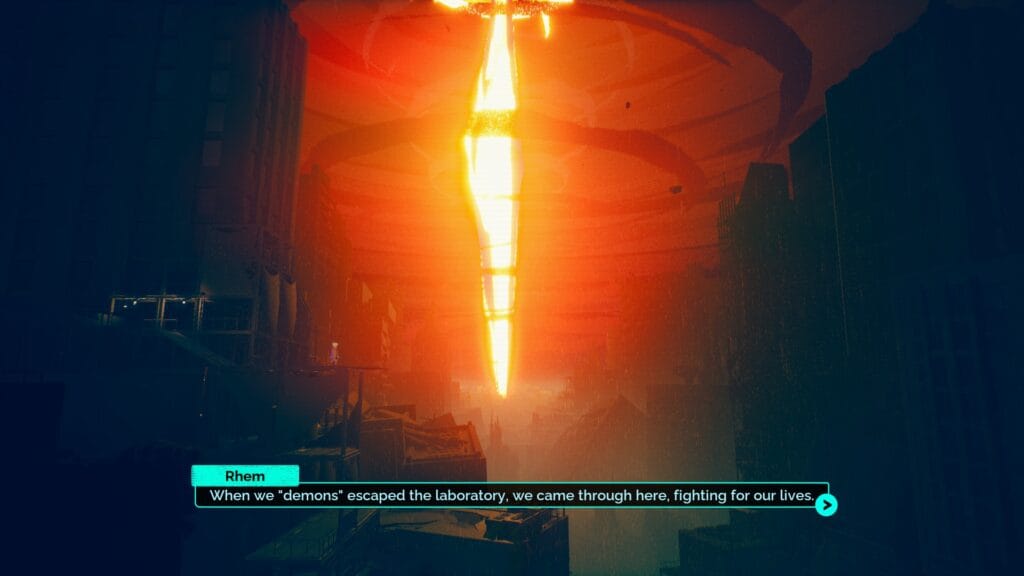
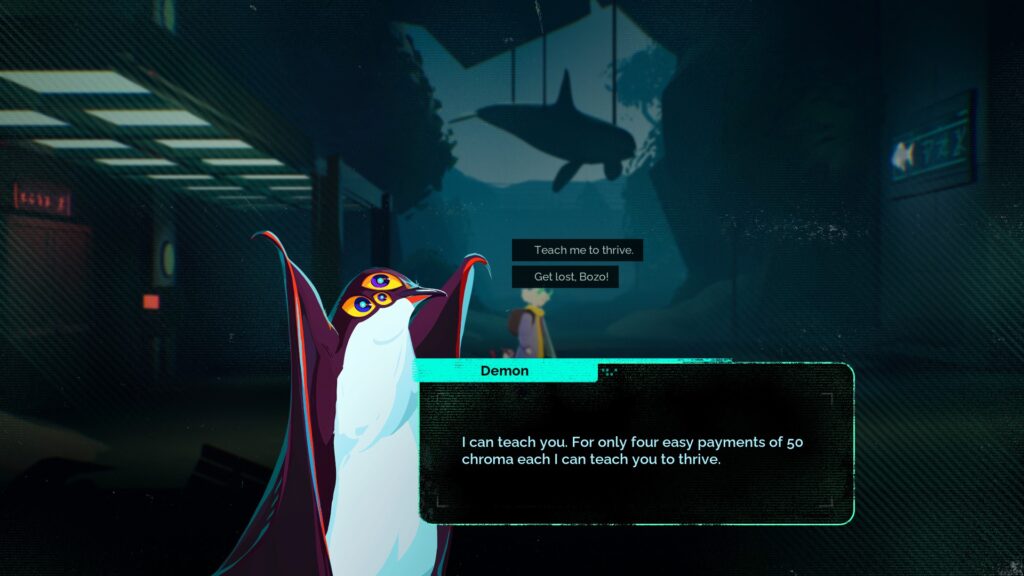
Demons in this world have no physical form and must possess something — be it any sort of living being or an inanimate object — to persist. Many happily settle for whatever they find, settling into life as a clock or stuffed animal. Some can coexist with their host like Rhem does with Luca, while others choose to consume their host entirely to assume complete control and physically manifest themselves in our world. Most of the demons running around Sanzu have gone feral, however, and have thus lost any sense of self, transforming all manner of life and detritus into otherworldly creatures or mutated forms. But Luca and Rhem aren’t willing collaborators. They’re regularly at each other’s throats. To call it an uneasy alliance would be an understatement. Luca is inherently distrustful of demons because of what they did to the city and to her friend. Rhem likewise has no love for humanity given the torture he and his kind suffered at the hands of Agradyne.
Agradyne is the evil corporation at the heart of the calamity that engulfed the city. Possessor(s) takes place in a company town, Sanzu City being owned and operated by Agradyne, a company who manufactures particularly strong batteries using “infinergy.” Everyone who lives there works for them, their residence conditional almost entirely on whether they’re actively employed by the company. E-mails from workers illustrate the absurd (but wholly believable) ways the company’s cruelty manifests. In one early exchange, one employee asks why so much of their handbook is redacted and whether they should be “sheltering in place” and continue working while the apocalypse is seemingly happening outside. The reply simply says yes, stay in place, Agradyne will have things under control soon. Even as the world falls apart, the work must continue: the line must go up.
It’s a particular sore spot for Luca. Her family is poor, her mother working constantly to try and provide for them and her ailing grandfather. They get by, but it’s hardly a good living. She’s a low-level employee and readily disposable. The company covers rent for their meager housing because they cannot afford it themselves. The precarity of their lives hangs over Luca constantly. In one scene, Rhem correctly observes the injustice in this arrangement, but is very blunt in his assessment, which sets Luca off because she’s once again, even amid the ruins of a dead city, reminded that she is poor and cannot escape that. Rhem’s seemingly confused how making simple observation is “rude,” unaware of the shame a lower-class upbringing inflicts on you.
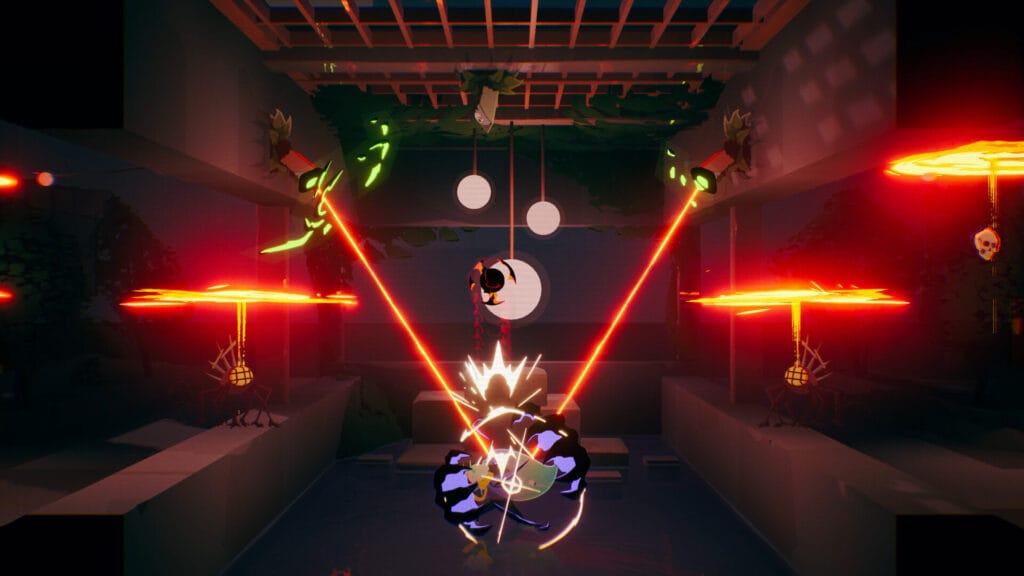
Posessor(s) is ultimately a story of abusive relationships (Luca and Rhem both being victims of this) and the hard work of coming to terms with that and moving forward, but it is also one that is deeply critical of the capitalist systems at the heart of society. The choice to make an evil corporation be at the heart of the disaster and responsible for the torture of the demons they captured and used to harvest “chroma,” the energy used to power the batteries they sell and manufacture, energy born from the literal lifeforce of demons, that the game also uses as currency for upgrades and gear, is a clear and conscious decision. It is not simply because it is an easy choice of villain, but a launchpad to specifically explore the myriad evils they enact on people. Much of this plays out in the margins, in e-mails and notices and documents, but it adds so much.
As a search-action game, it’s fine. Its greatest strength is how it doesn’t immediately roadblock you from exploring. Possessor(s) is linear on the whole, but it also won’t stop you from venturing surprisingly deep into different routes before you reach a gate. Combined with how hands-off the game is in terms of pointing you where exactly to go, it captures the best part of these games in how it encourages exploration above just following a marker to the next objective. Those still exist, of course, but as far as the main objective is concerned, they merely point out where you’ll be headed eventually rather than a breadcrumb trail to follow.
Past that its level design is serviceable. Traipsing across the city is pleasant thanks to Luca’s range of movement abilities that keep backtracking enjoyable even as you run through the same stretches of the city over the course of the game. Its weaknesses come from how limited the search aspect can be. Search-action, by its nature, leads to a lot of backtracking, especially as you try to fill in every corner of the map to see what, if anything, lies in wait. Possessor(s) spaces often leave little to discover past the initial run-through. They’re good at hiding secrets — I was thorough in my playthrough and still had plenty to track down — but so much of the world lends itself to a one-and-done pass that I didn’t feel much pull to go over every inch to chase down every possible item like I’m so often compelled. Possessor(s)‘ level design adheres to making each area mostly self-contained and built around whatever ability you obtain in their confines that you find little you can’t reach on your initial visit.
It’s effectively search-action in the classic mold, where the open nature of the level design is primarily linear and secrets are little bonuses you can find tucked in corners along the way rather than entire areas you can miss or something similarly substantial. For Poessessor(s), it works: it gives the game a constant momentum once you clock the path forward, the few moments you do decide to backtrack for something usually rewarding you with something of significance like a hidden boss. Discoveries like that are worthwhile because combat is one of this game’s strengths.
Possessor(s)‘ combat takes some cues from platform fighters. It’s largely about beating down foes enough to launch and juggle them while they remain helplessly soaring through the air and bouncing off walls. Different weapons alter the knockback strength of your attacks, which affects how you approach combat slightly. When I wielded the twin knives, my primary weapon for most of the game, I could juggle enemies with ease since they kept the enemy in close contact, but the trade-off is that they didn’t wear down the enemy poise much, so I had to be much more ready to evade at a moment’s notice. Compare that to the baseball bat, where every swing carries enough strength to send small foes flying with every strike (not always ideal since makes them take longer to vanquish) and wear down larger foes relatively fast, but is also slower and leaves you vulnerable on a whiffed swing.
Your main weapons are supported by secondaries that provide special attacks. A computer mouse is swung in an upward arc that launches lighter targets, a cell phone creates a burst of electricity around Luca, a leather glove lets her suplex foes, a skull can be summoned to fight alongside you, and so on. Most of them are everyday objects repurposed into weapons in fun ways. The numerous combinations of secondary weapons can be used to create combos or shore up weaknesses from your primary. I mostly settled into a set of attacks quickly because they worked well with the knives I favored, giving me attacks that dealt a lot of heavy damage quickly either via multi-hit strikes or a single focused hit, which offset the initial lower damage of the knives while still allowing plenty of easy juggles.
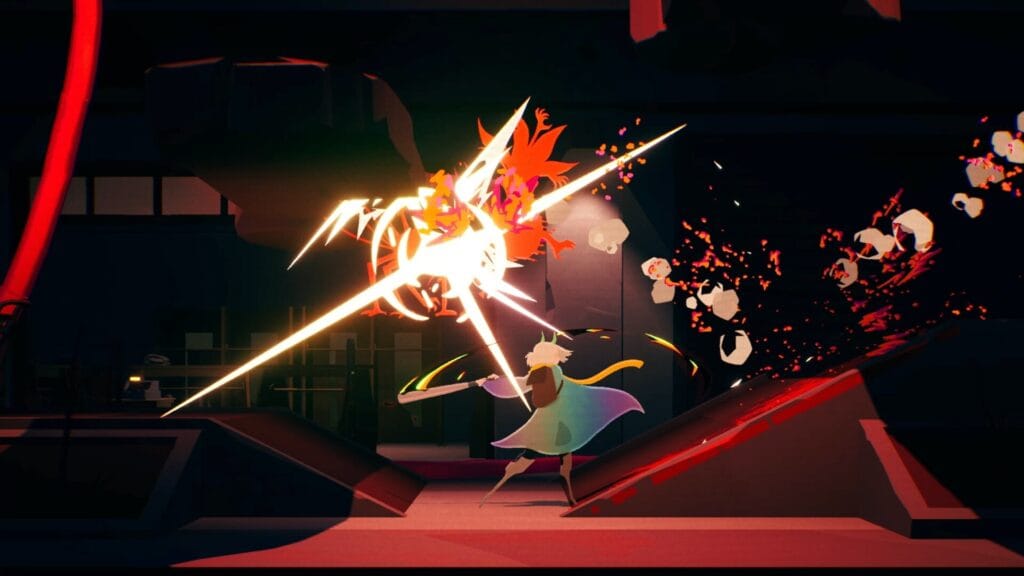
Combat particularly comes alive as you obtain more of Luca’s core skills, which serve both to unlock new paths to explore and add more options in battle. A forward slide can get you through crevices or under barriers, but it also lets her launch off whatever foe she collides with, potentially taking the enemy with her for an easy follow-up combo. The grappling hook obviously helps you cross chasms, but it can also latch onto enemies and chip away at poise and put them into a juggle state. It takes an otherwise simple moveset and provides some welcome variety and room for expression.
Even as I eventually tired of using the knives and longed for a different weapon (a hockey stick proving a splendid replacement), the actual combat itself never grew dull — at least in the moments that mattered. Encounters against the demons littering the streets do get old eventually after you’ve trodden the same pathways a dozen times, but that’s par for the course. Traversing those same hallways and streets at least remains enjoyable enough to bar the multiple trips through those spaces from becoming a slog.
It is a shame that so much of the team responsible for Possessor(s) is gone from Heart Machine. The story is one of the best Heart Machine has crafted so far, its take on search-action a fine foundation to build on. It would have been wonderful to see what else they could concoct together, but at least their last work under this studio’s banner is a memorable one.
Callum Rakestraw (he/him) is the Reviews Editor at Entertainium. You can find him on Bluesky, Mastodon, and his blog.