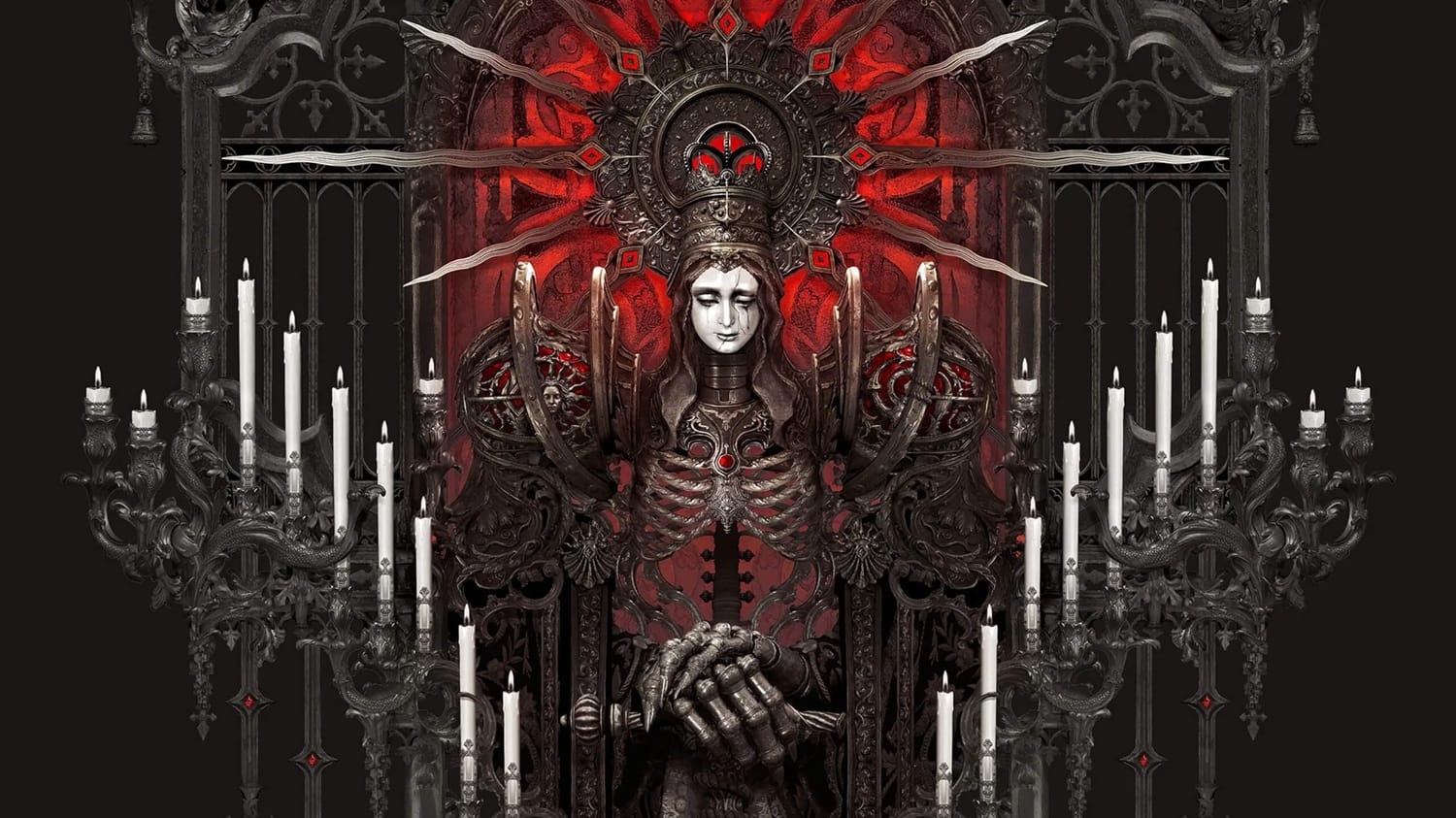
The original “golden age of Spanish software” was in the 1980s, and on a few occasions a new one has been tentatively proclaimed.Crisol: Theater of Idols is a reminder of the depth of ability in Spain’s development studios, one that – like The Stone of Madness and the Blasphemous series before it – draws interestingly on the country’s distinct culture. Crisol is a first-person survival horror game, set in a “twisted version of Spain” under the grip of a mysterious curse. While its narrative delivery is a clear weak point, the gameplay, art direction and especially the atmosphere will please horror fans.
Based in Madrid, developers Vermila Studio have previously focused on outsourced 2D and 3D graphics work for other companies. Their first in-house project, Crisol is published by Blumhouse Games, the growing horror-focused videogames subsidiary of Blumhouse Productions, known for various longstanding film series in the genre.
Players take on the role of Captain Gabriel Escudero, a steadfast follower of a supernatural entity called “The Sun”. He wakes up on a beach on the island of Tormentosa, informed via astral vision of his vital mission – to “The Sea”, a dangerous force which has escaped confinement and devastated the island. Tormentosa is no sun-kissed holiday spot, but rather a dark and storm-ravaged isle plagued by religious statues which have come to life, animated by The Sea and driven by a need to kill.
While it has its moments, the story of Crisol is delivered in a dispiritingly clunky style. At regular intervals, Gabriel is subjected to humdrum conversations with other Sun fanatics over his radio. If left unskipped, these slow our hero to a crawl; they also eliminate any tension, as these sequences and combat encounters are strictly exclusive. This poor story execution is quite reminiscent of Metro Exodus, also notably hampered by a similar issue.
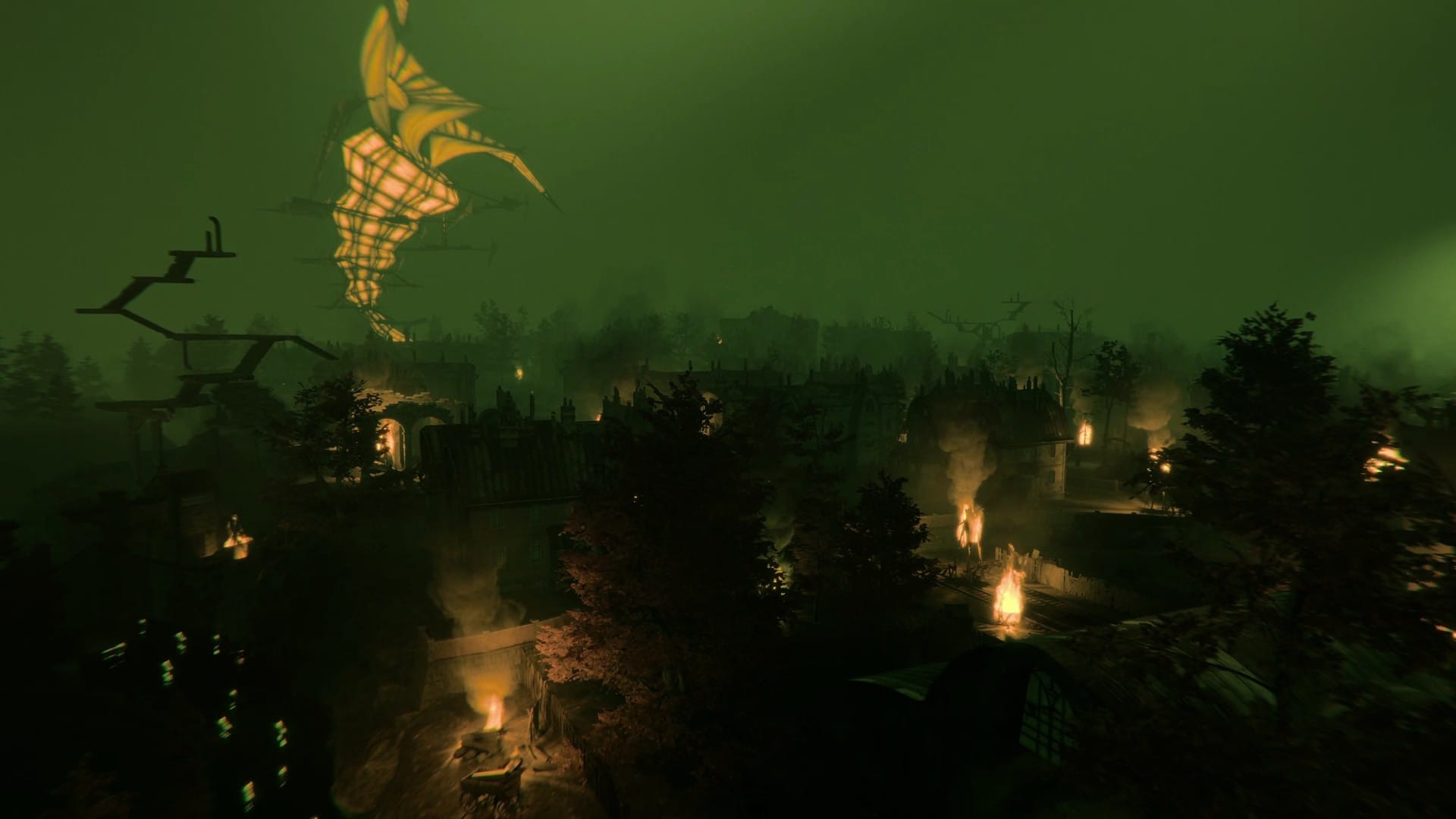
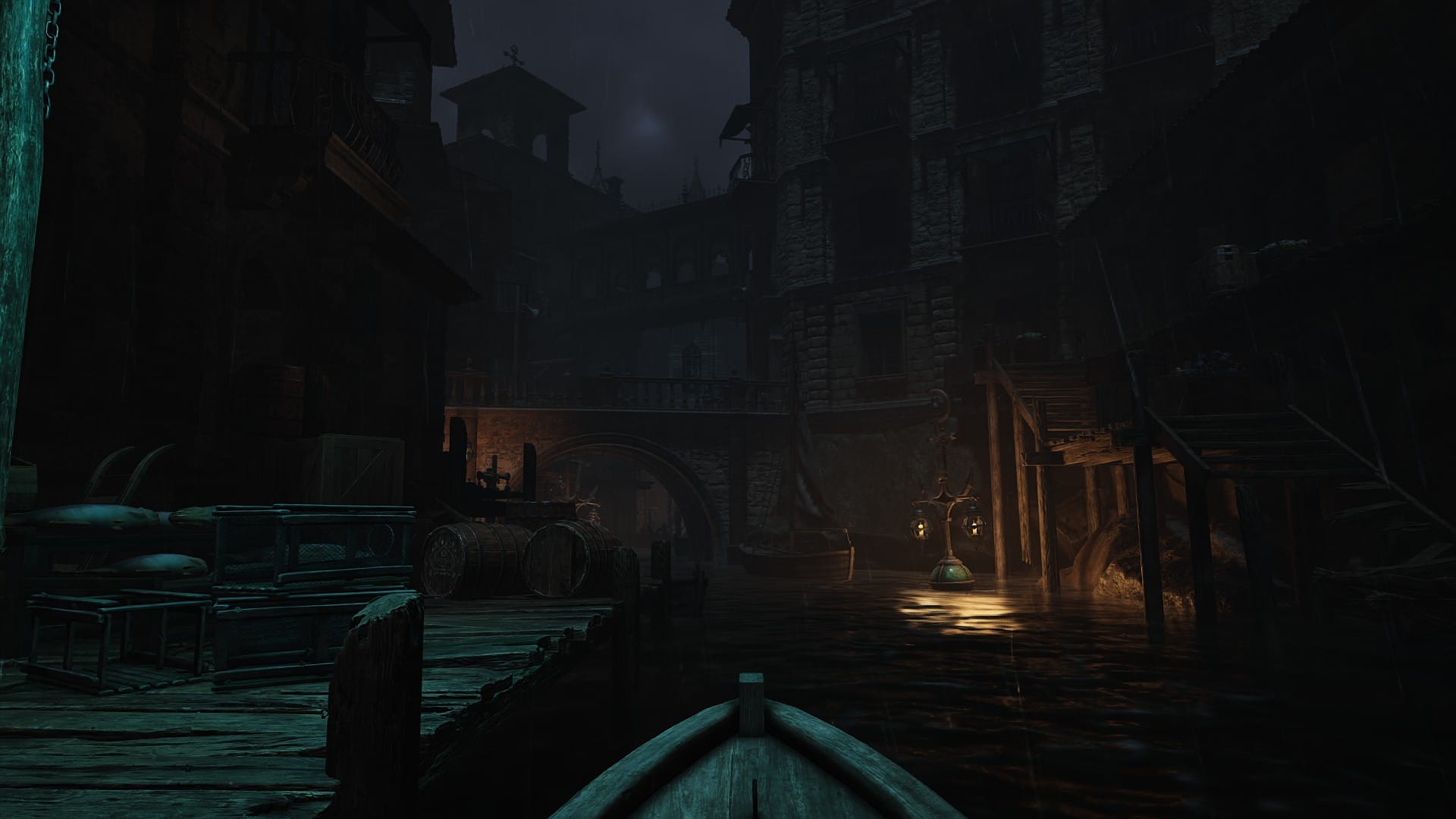
However, Crisol: Theater of Idols has some clear strengths and foremost among these is the visuals. Vermila’s extensive graphics and art experience is strongly showcased. Tormentosa is a wonderfully realised location, a darkly opulent settlement fallen abruptly into nightmarish ruin. The island is varied – a patchwork of coastal cliffs, markets, night spots, a funfair, industrial facilities, mines, and religious edifices. The art direction is assured and consistent, and the environments are all packed with detail. Parlours are strewn with books, upended furniture, and ornaments – their floors stained with blood. Subtle decorative elements are everywhere, from the hooved feet of barstools to the ornate posters which seem to date the setting to the early 1980s.
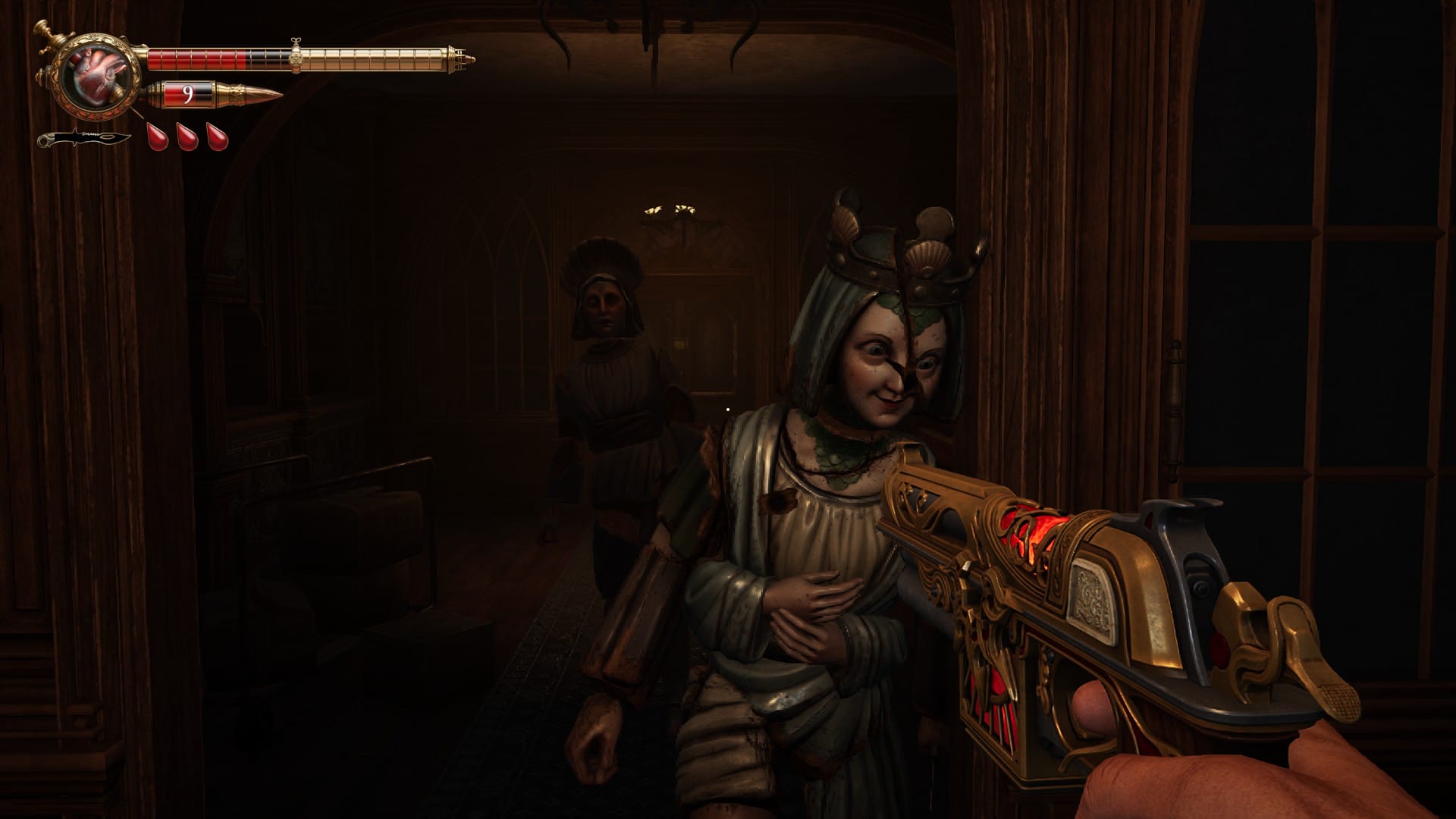
The enemies are also superb imaginative creations. The living statues make up the majority of opposition to Gabriel’s progress. While rarely truly scary, they are unnerving – lurching haphazardly through the streets and corridors, creaking as they swing cleavers or press ahead with tridents. Ironically, they are much more authentically alive than the few human survivors encountered by Gabriel, who are rooted to the spot and afforded limited animation.
Progressing through Tormentosa to acquire the means of restoring an arcane seal involves a combination of exploration, combat, and puzzle solving. The island is divided into three main districts, none of which are particularly large, but Crisol proceeds at a slow and steady pace. Although a soldier, Gabriel is not a very mobile protagonist – his walking speed is slow, and he cannot jump. In another kind of game, the player would simply be able to hop over some of the obstacles that delay Gabriel significantly.
Gear-gating is used to control the player’s progress; for example, acquiring a brake lever allows Gabriel to move mine carts in Chapter 2. Crisol: Theater of Idols is broadly very linear, but occasionally these thinly disguised keys allow access to side areas, where extra silver coins, upgrade items, and health syringes may be found. Unfortunately, the special powers which Gabriel can acquire are disappointing – being able to use a health syringe 10% faster is hardly exciting.
Combat has a deliberate pace. The cursed statues stagger quite slowly towards Gabriel, almost always attacking from the front. Most of the guns have slow rates of fire, at least until upgraded with those silver coins at the mysterious vendor, “La Planidera”. These weapons have a crucial twist which sits at the heart of Crisol gameplay – magically modified by The Sun, they use Gabriel’s own blood (and therefore health) as ammunition. In theory, this necessitates careful resource management. In practice, Vermila seem worried about the implications of this unified ammunition pool – plasmarine shots, which restore Gabriel’s blood, are common – particularly in Chapter 3.
In some senses, Crisol: Theater of Idols is a game that should not work. While it superficially resembles a straightforward FPS, its slow gameplay and largely banal weapon selection will not appeal to the shooter hardcore. Conversely, it does not deliver enough scares, nor exploit resource scarcity effectively enough, to be a truly great survival horror game. It delivers its story in a lacklustre way, and concludes with a grotesque but trivial boss battle.
Despite these shortcomings, Crisol somehow does work. Its imaginative vision and aesthetic are so inspired and consistent, its sense of atmosphere so assured, that it summons up a special charm all of its own. A first-time game for its developer, Crisol wears its influences on its sleeve – especially BioShock and Resident Evil. It may be flawed, but it also may yet prove to be a powerful springboard to greater things.