My experience with bullet heaven games is limited. I understand the appeal – the rapidly increasing strength of your offense, literal waves of projectiles spreading out from all around you, are appealing on a raw lizard brain level. But the process of play felt very plain. Moving around an arena decimating massive hordes of monsters has an innate appeal, sure, but it never got its hooks in me. A single run was enough to satiate. I’d rather just play a vertical shooter and dodge bullets than be the one spraying them. Blood Dungeon, on the other hand, clicked because the framework is packed in a form that is immediately more engaging to me: a platformer.
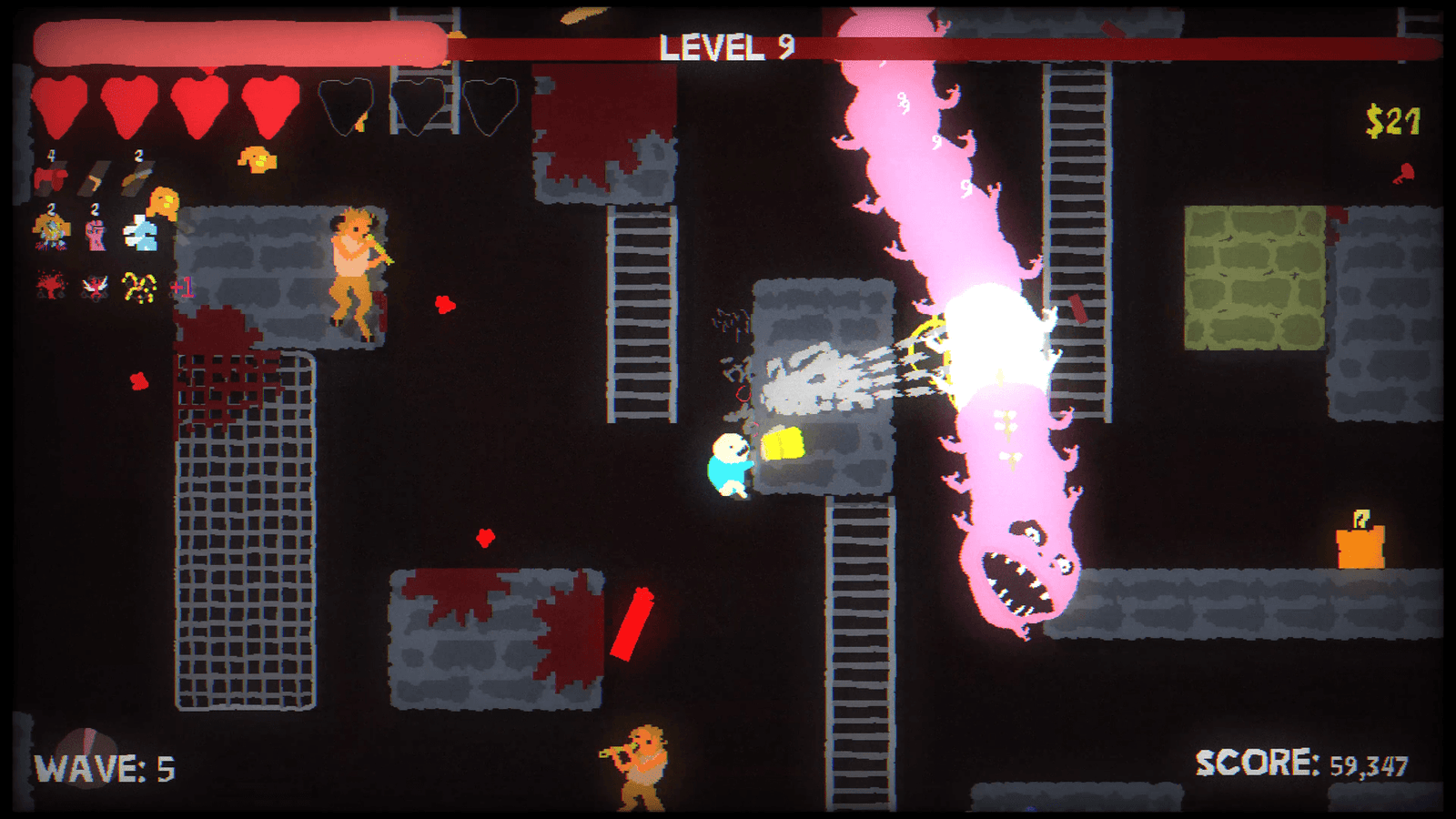
The action and style of chaos a platformer provides makes navigating the endless waves of enemies much more harrowing. Not only do you need to find or create openings in the mass of creatures descending on you, but you have to take the level geometry into consideration. It encourages you to be in constant motion, always moving forward trying to stay ahead of waves of foes behind you, pushing you to take risks as you try to squeeze through whatever crevice you can find because you desperately need to get out of this alcove. A lot of Blood Dungeon‘s levels loop around on themselves, which makes staying on the move easy. Simply never stop moving. The few that don’t require more finesse and a bit of luck since you can end up trapped easily if you’re careless.
For example: the first level, Catacombs, is a large square space. You start closer to the bottom of the stage and have ample room to move upward. Routing is tricky because of how densely packed the space is, but it also ensures you aren’t likely to end up stuck somewhere unless you spend too much time near a wall or in a corner. The second level, Corridor, is a forested horizontal stage that loops on itself. Despite allowing constant forward movement, the lack of vertical space and combined with the density of walls and barriers means it is a struggle to stay alive once you’re several waves deep.
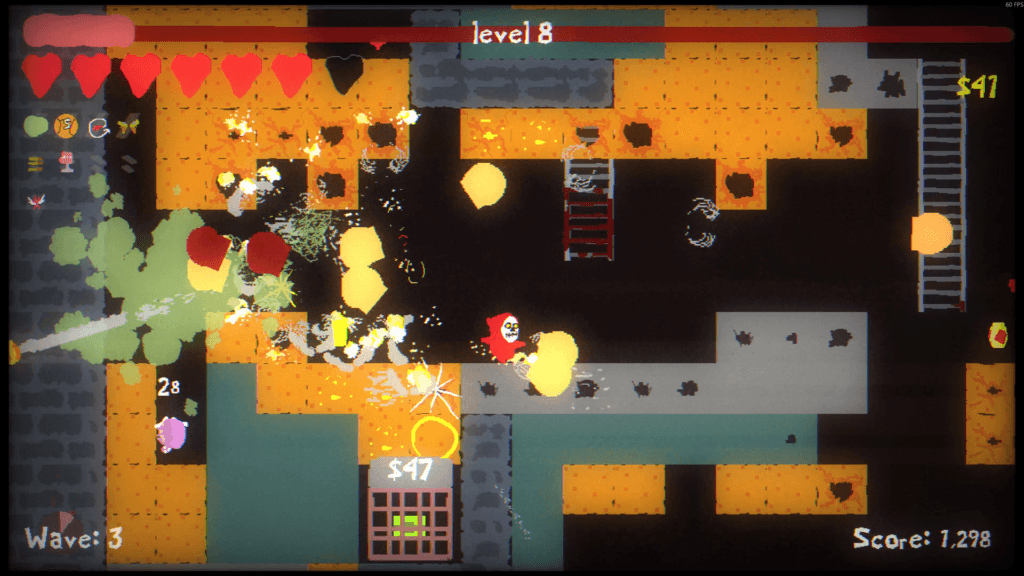
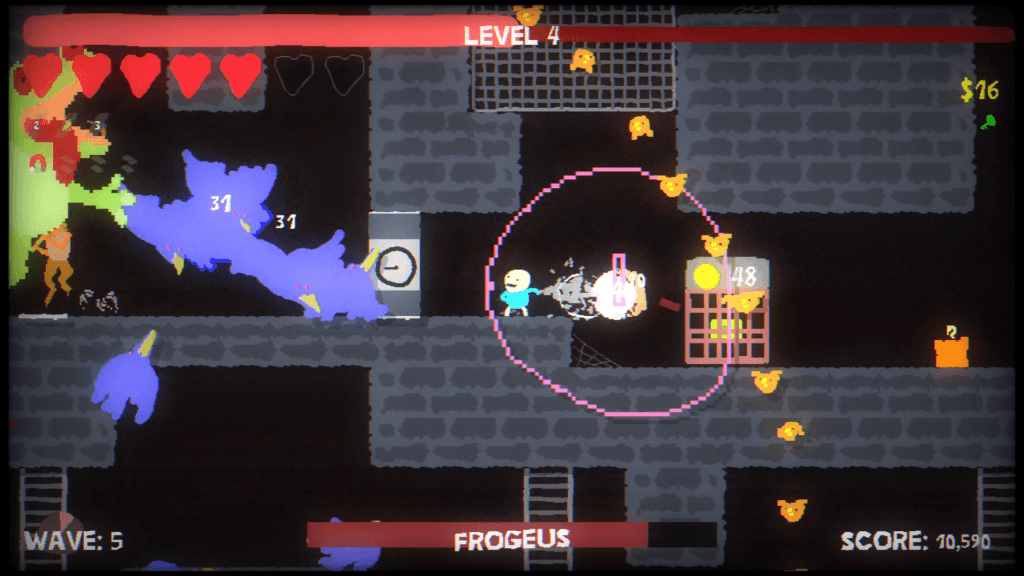
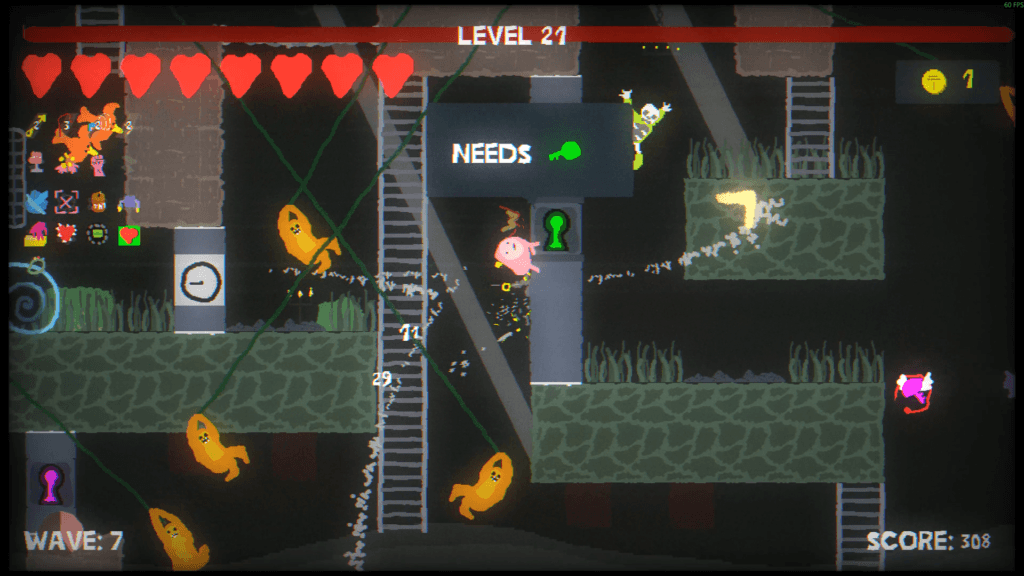
The utter chaos that erupts once you reach that stage is where Blood Dungeon shines. It doesn’t take long for the action to get out of control, enemies pouring in from every angle and occupying whatever empty space they can, rapidly encroaching on you like a horde of hungry zombies. Finding a way forward amid the constant assault is complicated by the winding level design, every small opening a gamble of whether you can make through before it closes entirely or without getting grazed by an enemy along the way. The dynamics of navigating the unmanageable swarms of monsters surrounding you is what makes Blood Dungeon‘s choice of being a platformer a perfect fit. It adds an extra degree of unpredictability regarding jumps, both the arc and the height, that leads to the right kind of unintended actions. It’s not so hard to pilot anyone, nor are the controls finicky, but rather it leverages the fast movement speed and intensity of the moment-to-moment action to enhance the resulting scrambles.
Whenever I’m in a bad spot and need an escape now, it’s good to be forced to decide between forcing my way out and suffering whatever consequences follow or staying put and hoping my damage output is enough to allow me to stand my ground long enough to create a safe(ish) opening. In a traditional shooter where you’re dodging bullets, the experience leans more zen than overwhelming. Bullet patterns are predictable and consistent. You can move slowly and thread the needle between individual bullets. Your focus is only on watching patterns and navigating their intricate webs with precision. The predictability and the steady process of learning how to proceed unscathed is what makes those games thrilling, whereas Blood Dungeon‘s inherent randomness forces constant adaptation, which itself is thrilling in its own way. It’s a series of constant decisions that test your ability to survive under insurmountable odds.
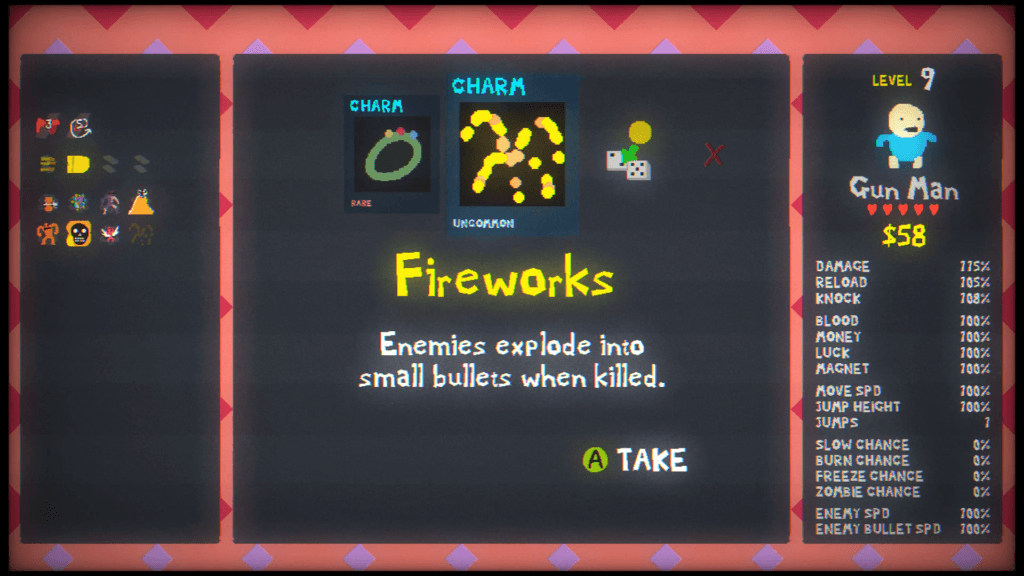
Contributing to this is how quickly the level-up rate slows down. Once you hit level 10, the amount of blood you need to collect per level increases drastically. You effectively have to lock into a build fast as you can’t count on getting a ton of extra upgrades outside of leveling up. While some stronger foes, indicated by their flashing outlines, can drop upgrades on death, it’s just as likely that they drop a sum of coins of a hefty glob of blood instead. Some levels make obtaining additional weapons and charms easy due to the sheer number of chests available to open, but many require large sums of coin to unlock, which is itself rather map-dependent. Tomb has coins aplenty buried everywhere, ensuring you’re often carrying enough to spend whenever a few waves in, whereas Corridor is a struggle to gain cash in due to having to rely on it dropping from enemies on top of having fewer pedestals to purchase upgrades from.
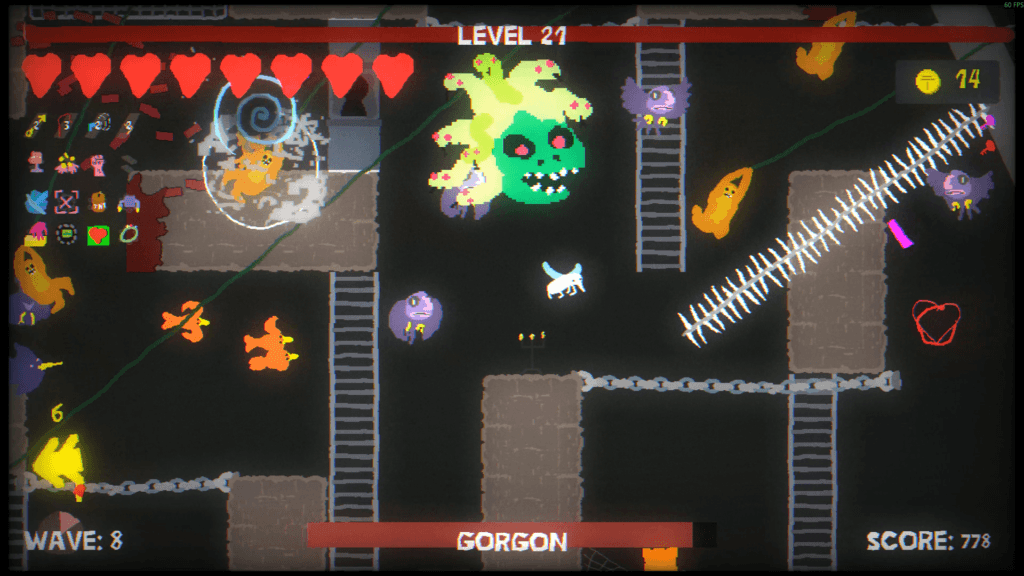
Blood Dungeon‘s loop is that of your typical roguelike. On finishing a run, be it a success or failure, you receive a number of bones to spend on permanent upgrades like more health, faster movement speed, extra weapon slots, and so on. New levels unlock quickly just by playing. Characters, weapons, skills, charms, and the rest are all obtained by completing challenges mid-run, such as staying airborne for five seconds or reaching the second boss of a certain level. Every character has their own passive bonus and starting weapon that establishes their basic play-style. Leggy starts with webs that slow enemies down and slowly deal damage over time and has a bonus to their luck stat, while Leech has a whip and gets faster cooldowns.
The bonuses each character gets don’t drastically alter play, but they do influence what upgrades you might prioritize. If someone has a naturally fast movement speed, I’ll grab the charm that makes weapons fire more often as I move faster, whereas naturally higher knockback might be something I lean on in favor of increasing it further through upgrades depending on what my first few levels look like. The more comfortable I got with the game, the more I began to consider what I actually wanted to build around if possible rather than taking whatever sounded good in the moment (though that’s still very much necessary for an average run).
By the time I felt done with Blood Dungeon, only two levels remained unfinished. I never saw myself getting into any of these games, but Blood Dungeon‘s particular spin clicked with me more than I expected. The more active nature of platforming lends more interesting decision making, which in turn gives Blood Dungeon‘s runs more excitement. It’s a good time, something I enjoyed more than I expected to.
Callum Rakestraw (he/him) is the Reviews Editor at Entertainium. You can find him on Bluesky, Mastodon, and his blog.