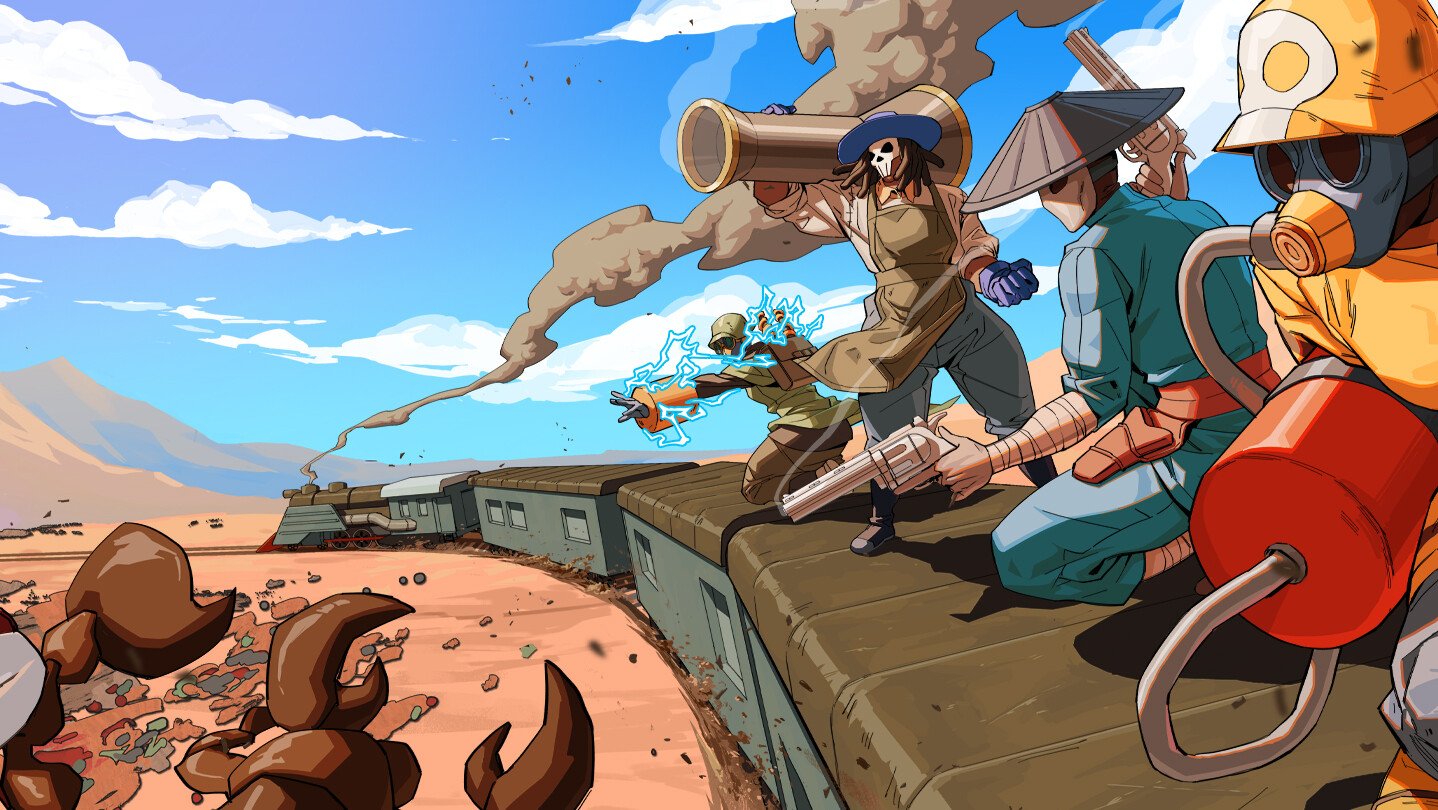
It wasn’t the launch they had planned. Having had their community choose its supremely unwieldy title, Rami Ismail and Aesthetician Labs were all set to release Australia Dit It: End-of-the-World Railway Defense Business on 10 November. The big day came and went, due to frustrating delays with Steam’s approval process – likely due to it being increasingly clogged up with AI-generated slopware.
Ironically, Australia Did It actually was in need of some extra time in the oven. At the time of writing, this post-apocalyptic turn-based tactical roguelike is marred by numerous bugs, UI flaws, and stability issues. The game is also lumbered with a largely pointless and flat-out boring autobattler mode, which serves as an interstitial minigame between the tactical scraps. This is unfortunate, because Australia Did It has a great idea at its core.
An animated opening cutscene gives the sketchiest outline for the game’s flimsy narrative foundation. It’s your usual, off-the-shelf post-apocalyptic scenario, and trains are used to transport cargo of some kind to… somewhere, for some reason. Hostile mutants roam the land, and apparently it’s cheaper to hire armies of mercenaries to protect the trains than it is to armour them properly. This gossamer-thin figleaf of story is all that is on offer, but it is of no importance.
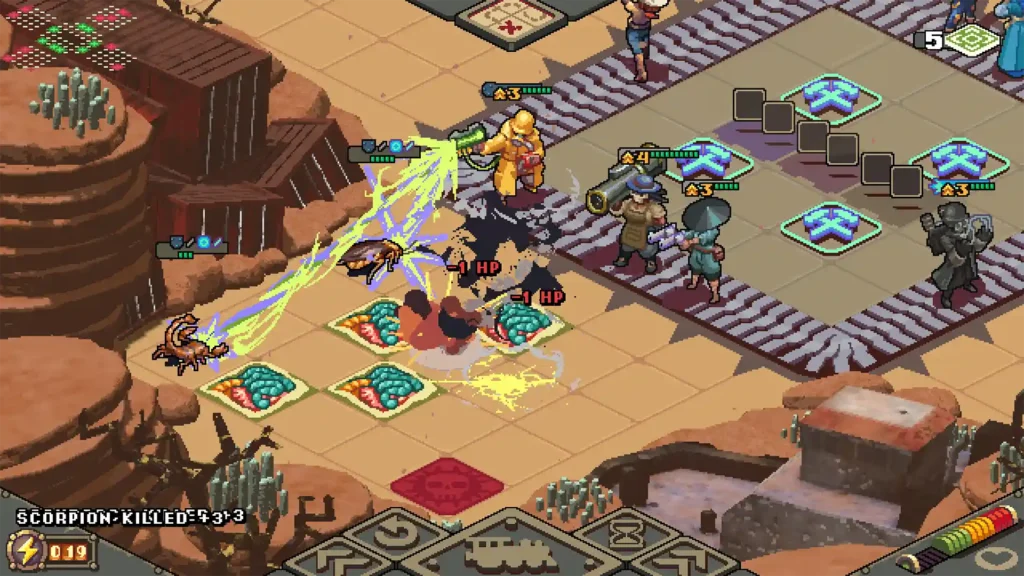
The station mode – that is to say, the good mode – is a kind of turn-based tower defense scenario. Players must position units to hold off hordes of mutant insects, rogue robots, malign plant life, and eventually jackbooted shocktroops. A controllable “rail” can be used to shift any mercenaries standing on it into new positions, to better face the threat. Fundamentally, this is a solid but very ordinary setup.
The ingenious gimmick is that for some inexplicable reason, mercenaries can be merged together into new types. From a starting selection of three soldiers of fortune – the Radshot, Cowboy, and Nomad – an impressive roster of over 30 unit types can be forged, with something like 1,500 specific subtypes with subtle differences. Initial merges are not too exciting. Merge a Cowboy into a shotgun-wielding Nomad, for example, and the new level 2 Nomad will simply do one extra point of damage. If the merge is done the other way around, a level 2 Cowboy will gain one point of knockback.
It’s at level 3 that things really get interesting. The Hazmire – made of two level 2 Radshots – not only irradiates enemies and shreds their health over time, but also weakens them, cutting down their damage potential. More elaborate merges include the Mine Thrower, the devastating cyborg V-Cannon, the PRAC-03 rocket artillery, which does damage equivalent to the number of foes it has marked for death. Interestingly, the mercenaries are all women, and all have been lovingly designed in characterful pixel art. Discovering each distinct type is a constant thrill, even if a few are so niche in function that it can be tricky to find a role for them.
The roguelike gameplay loop is well-crafted. Turns survived and foes vanquished both award a currency, cindermint, that is used to summon new level 1 mercenaries to begin new merges. After each battle, a perk is awarded which can be assigned to a specific unit. These can transform the effectiveness of a character over the long term, especially if – for example – it increases their movement speed or the number of times they can attack per turn. As is usually the case with this kind of system, some perks seem so weak that it is hard to imagine ever picking them, but this is a minor complaint.
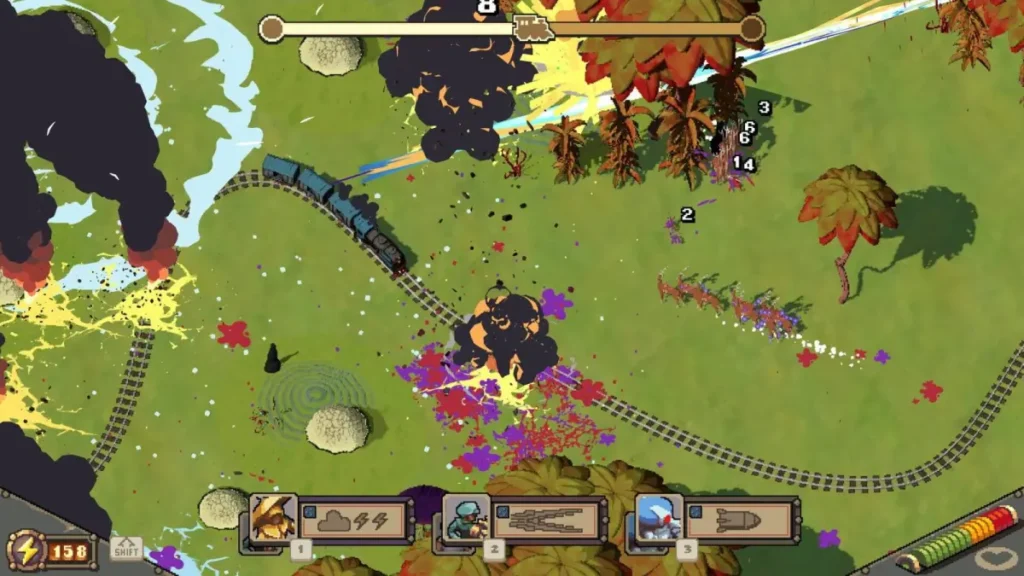
A much more serious problem is the entirely uninteresting journey mode. This is a passive, autobattler minigame focusing on the train traveling between stations and it is an unmitigated flop. Up to six mercenaries can leave the station at the close of each mission, and they deploy their abilities to defend the train on the move – but in a largely opaque way. The mode is a visual mess, obscured by an excessively large UI and distracting environmental effects. While mercifully brief, the journey mode is a total drag, in its own way perhaps even more annoying than the between-mission segments in Warhammer 40,000: Mechanicus.
There are numerous other small issues with Australia Did It which add up. The tutorial is poor and the compendium of unit merges and enemies is short on useful information and in need of a comprehensive redesign. There are missing sound effects, there are tiny unreadable icons, and occasionally the journey mode will simply fail to end. A flawed enemy characteristic system makes battles more confusing than they should be – for example, robot enemies are immune to radiation damage but this is not indicated where it should be.
Rami Ismail has a formidable pedigree, and at its best Australia Did It recalls the crunchy addictiveness of Nuclear Throne. At its core, this is a clever and inventive, though short, tactical roguelike. It never really threatens to be the equal of the the superlative Into the Breach – another game it resembles in some ways – not least because the journey mode is such a sad liability. It is likely that patches will lift Australia Did It significantly, but some of its issues are probably too fundamental to be corrected. At its best it is a great time, even if it is no match for the best in class.