Almost everyone has heard of Dante Alighieri, even if most people haven’t actually read any of his works. The Divine Comedy is considered to be not only the foremost text of the Italian language, but also one of the greatest works of literature more broadly. At the time of Dante’s life during the late 13th and early 14th Century, most liturgical and scholarly writing was still conducted in Latin, and thus out of reach for even reasonably educated rich people. Dante instead wrote in vernacular dialects of the time, which brought his writings to a much wider audience. In Italy, he is regarded as the national poet, a position only Shakespeare really holds in the English-speaking world. Indeed, T.S. Eliot once remarked “Dante and Shakespeare divide the modern world between them; there is no third.”
One-O-One Games’ The Alighieri Circle: Dante’s Bloodline is a story-driven walk-’em-up with puzzles, imagining that Dante’s inspiration for writing The Divine Comedy was not purely a result of his brilliant intellect. Instead, Dante’s family is cursed to have to perform a ritual every 33 years to prevent the gates of hell reopening and consuming the world, the person undertaking the ritual being transported into hell in order to do so. You play as Gabriele Alighieri, a direct descendent of Dante, in the 1990s. Gabriele has been brought up to expect to perform the ritual, but is still frightened of what it might entail. You arrive at the Alighieri Villa in Italy at night, and after a phone call to his wife Dalila, Gabriele begins his woeful errand by descending to the crypt.
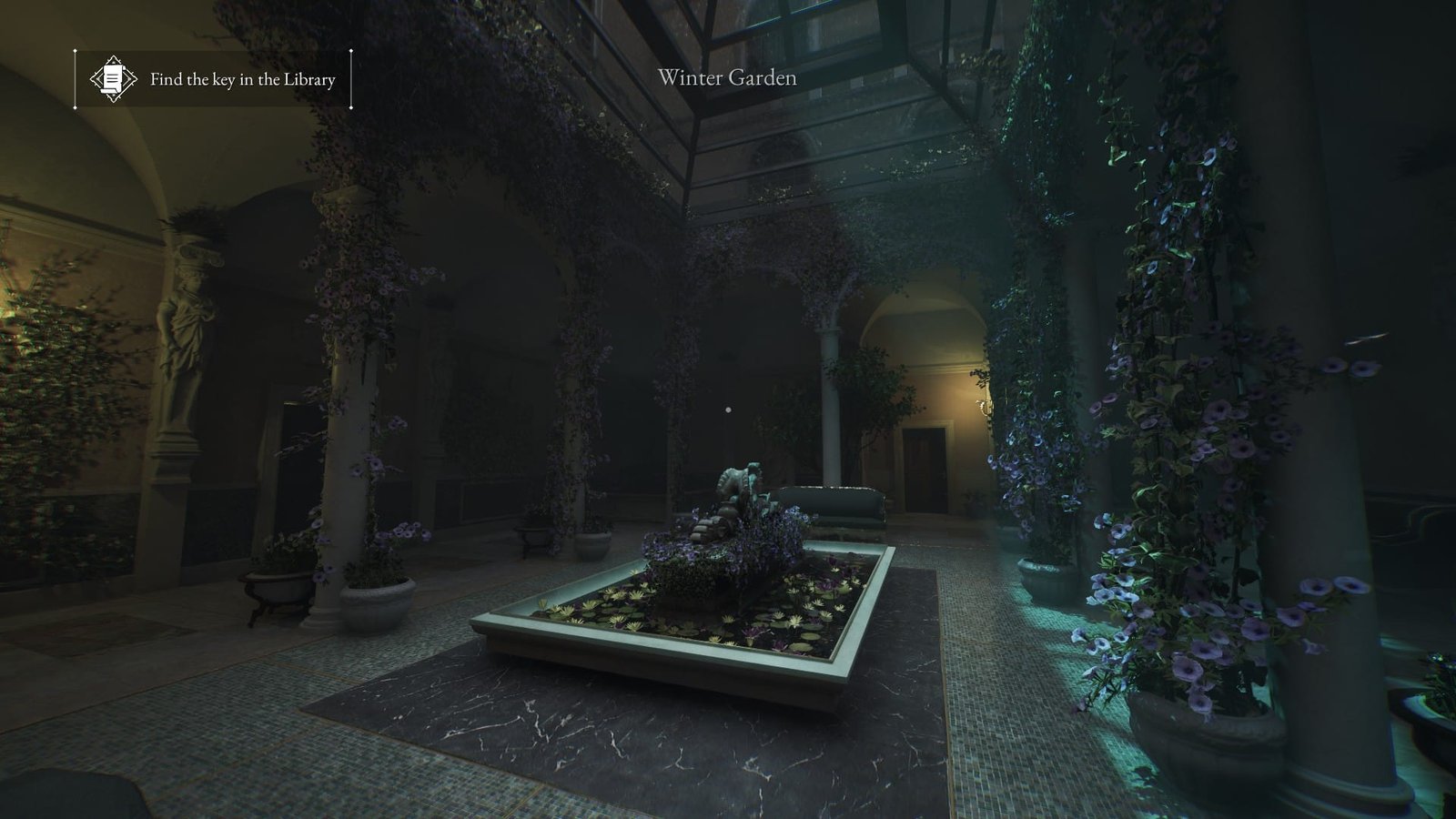
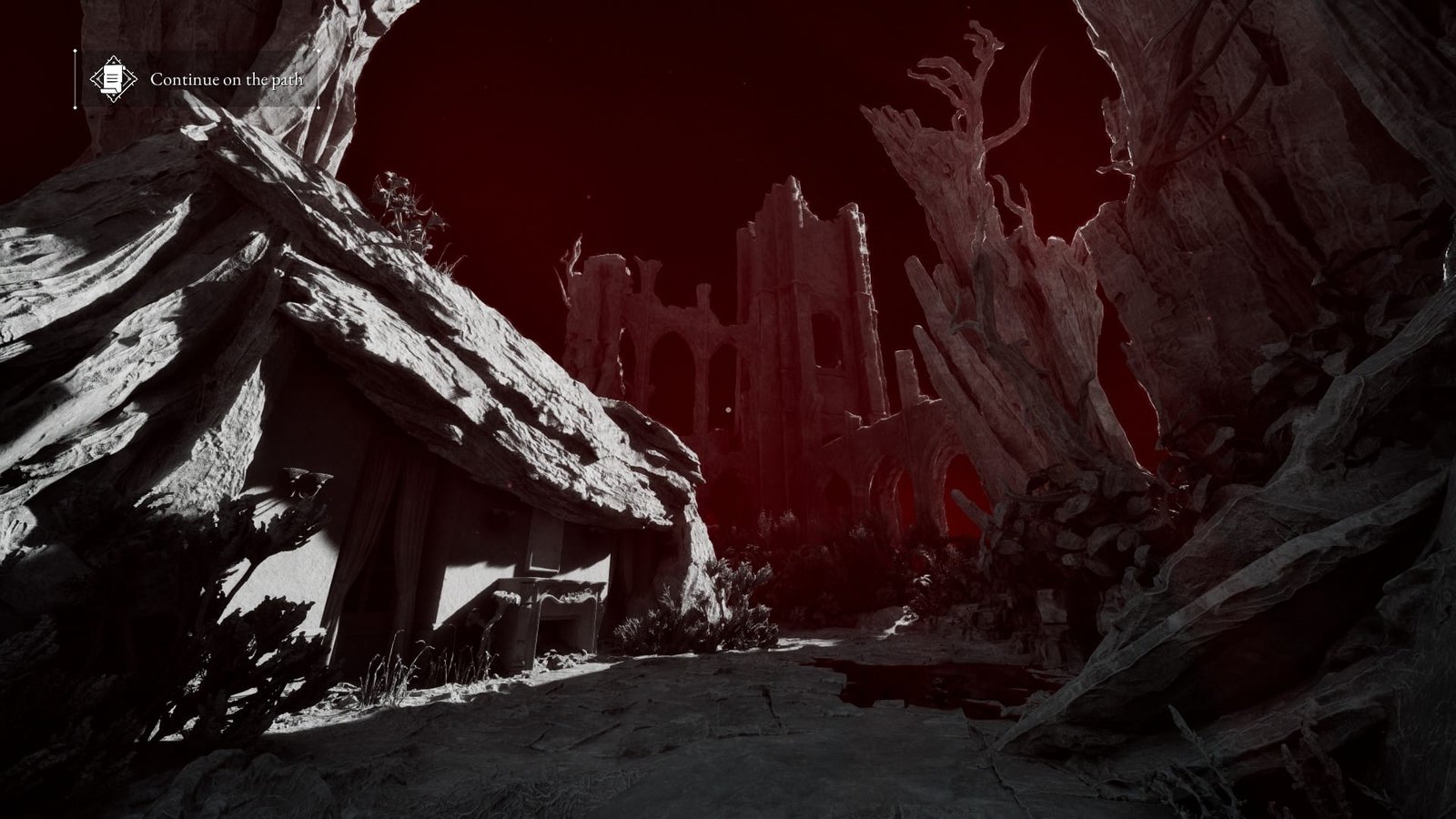
The gameplay is fairly straightforward walk-’em-up/walking sim, but with some occasional puzzles thrown in along the way, a sort of Myst-lite experience. You split your time between the beautifully rendered interiors of the Alighieri Villa in the real world, and the fantastical, nightmarish realm of The Dive; the layers of hellish landscapes conjured by Daniele’s own mind and the demonic forces intermingling. You walk around examining the world and occasionally interacting with objects, and the story unfolds gradually as you do so. It’s almost wholly linear except in a few areas, or when walking around the villa. Gabriele is guided by a nominally friendly Ancestor figure when inside The Dive (who is a disembodied voice), but the Ancestor’s true intentions may not be what they seem.
Voice acting is reasonably decent (the voice actors are named in the credits but not assigned for their individual roles), although Gabriele’s reactions are sometimes a bit over-the-top, but the Ancestor sounded nicely authoritative. Unfortunately the plot feels a little one-note; I wasn’t really invested in whether Daniele was successful or not at closing the gates of hell, and I found him regularly worrying about his wife Dalila more annoying than endearing. Likewise there is some backtracking now and then, returning to the villa to basically just answer the telephone, and as far as I can tell nothing in the villa had actually changed when doing so. It does break up The Dive’s nightmarish landscapes but it felt like a missed opportunity. This also isn’t really a horror game either; there are a few jump scares but nothing major, and there’s never any actual peril.
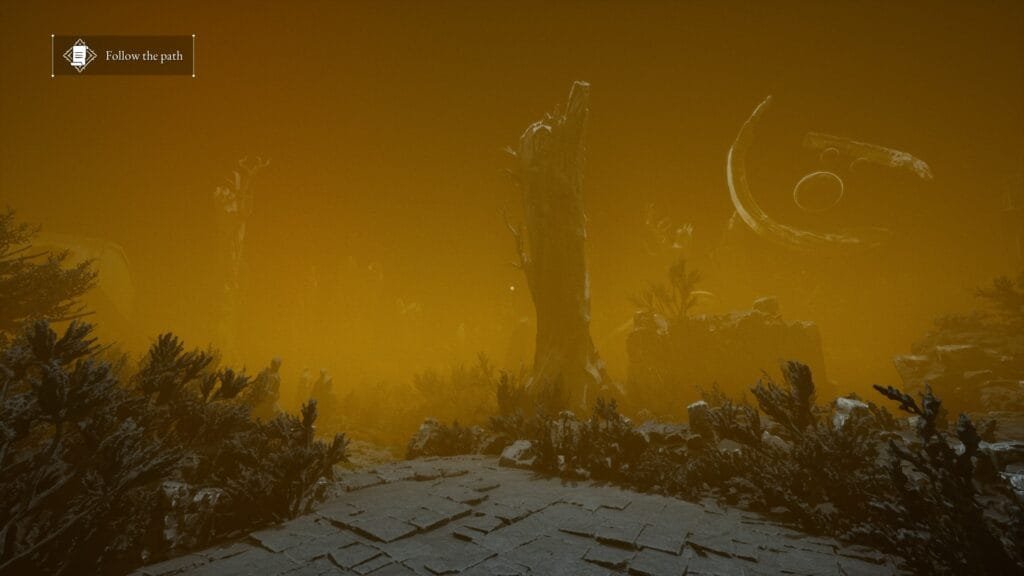
The walking simulator sections are broken up by some occasional puzzles; the first major one is a bit long-winded and did involve me having to work out the solution on a piece of paper, but to be fair to the game it did provide all the necessary clues for deduction, even if then inputting the solution was rather time-intensive, involving multiple spins of a large wheel. There are also some navigation puzzles where you have to make a wall of condemned souls march in a particular direction, in order to clear a path forward. The three main trials of the plot are separated with a few more minor ones. Visually though this game can’t be sniffed at; the interior of the Alighieri Mansion is sumptuous and the bizarrely twisted and deformed environment of The Dive looks like a cross between a heavy metal album cover and ancient Roman ruins smashed together.
The Alighieri Circle: Dante’s Bloodline certainly does have some atmosphere, but the journey was over shortly after the plot finally got reasonably interesting, and the entire experience can be fully explored after a few hours. It’s worth seeing for the wonderful visuals but I didn’t feel like I learned much about Dante Alighieri or The Divine Comedy, not that that was the primary aim. If compared against something like The Magnificent Trufflepigs, a walk-’em-up I reviewed back in 2021, The Alighieri Circle is more accomplished and satisfying, but fails to reach the greats of the genre like Dear Esther or What Remains of Edith Finch.