It has been a decade since developer Jonathan Blow and his studio Thekla, Inc.’s last major game, The Witness. Although inspired by the Myst series of puzzle games, The Witness was an extremely different experience because it was a puzzle game where the primary reward for completing puzzles was getting to solve more puzzles, and where the puzzles themselves were the main draw, rather than some interesting narrative tidbit or exploration. While the puzzles themselves were excellent, I found The Witness frustrating because it had so little to say for itself, in terms of themes or philosophy.
Order of the Sinking Star, Thekla’s new game, seems like a conscious attempt to give a bit more story and some deeper worldbuilding alongside the puzzles this time around, with lots of voice acted characters as well. It certainly doesn’t skimp on the puzzles however which remain the central draw, giving over 1,000 different puzzles scattered across its vast world, occupying potentially hundreds of hours of your time if you’re so inclined. Order of the Sinking Star is one of the largest and most complicated puzzle games I’ve played, but also one which masterfully builds upwards from its first principles, unleashing more and more complexity along the way.
You predominantly play as The Queen, who has been transported into a magical realm following a battle where it is implied the Queen was killed, and this may be some kind of afterlife or purgatory. She is dropped into a huge, interconnected land made up of many different biomes which is initially gated off, until you complete various different sets of puzzles. You navigate around a grid-based world, using either keyboard or controller. Each square you move can be rewound or undone at any time, and you can also rewind immediately back to the start of a new level (except within the Overworld). Each of the cardinal directions from the starting zone features a different array of puzzles. To the north lies The Hearty Heroes of Hauling and is the suggested starting point; puzzles focused around pushing, pulling or moving blocks, inspired by Sokoban (1981) and specifically the Heroes of Sokoban series by Jonah Ostroff and sliding block puzzles more generally.
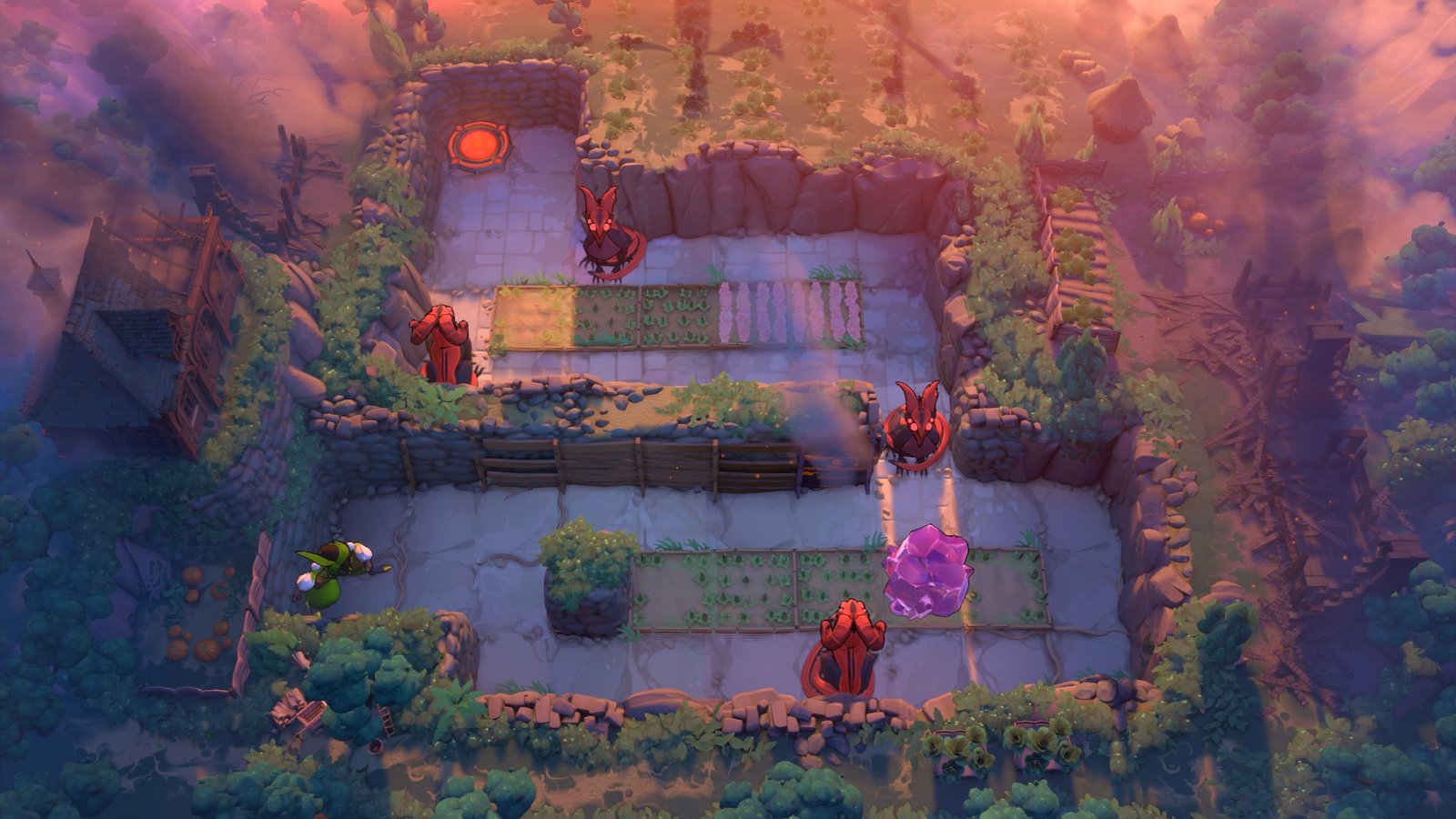
Whenever you start a mini set of puzzles, you’re transported to a standalone zone for each of them, and will control various different heroes. For example, early puzzles in the Hauling zone feature a Gauntlet-esque trio of a warrior, a thief and a wizard. The warrior can push blocks, the thief can pull blocks, and the wizard can swap places with them. You can swap your control between each of the characters on the fly, meaning you’ll need to think about how to best use their abilities to solve each puzzle, which usually requires the heroes to reach the finishing teleportation pads. Each puzzle is accompanied by some voice over narration from the characters recounting their adventures, although they also seem somewhat mystified about what they’re doing in this strange land. If a hero ever dies, it’s simply a case of rewinding to undo your last mistake, with infinite redos.
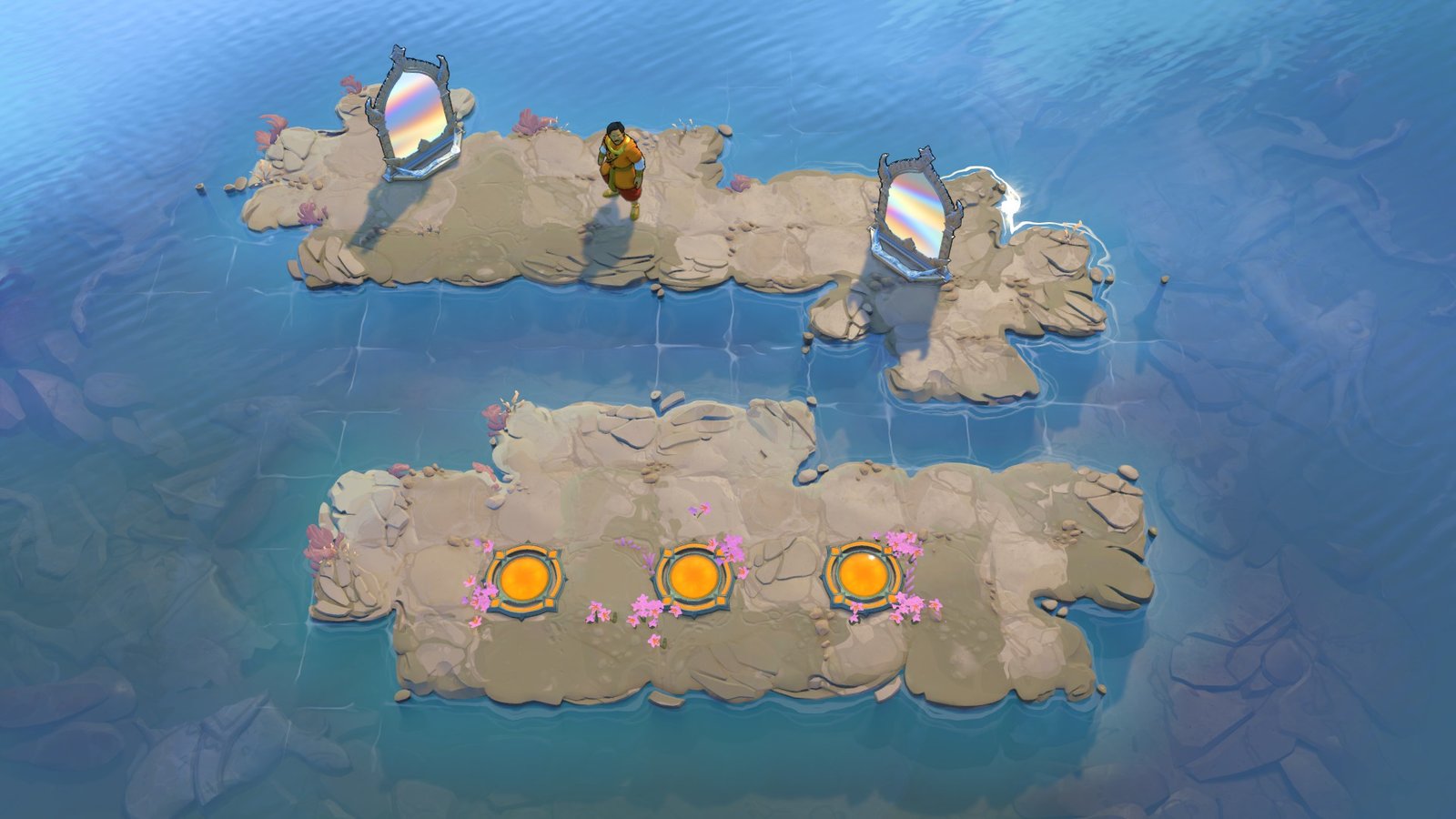
To the east lie the Mirror Isles, inspired by the similarly named indie game by Alan Hazelden. As the name implies, the puzzles here focus around mirrors and teleportation. Each mirror can be moved around but not necessarily changed in angle, but the mirror allows for you to teleport across bodies of water, provided you’re able to walk far enough away from it, as the distance you teleport is equal to your distance from the mirror. You can also accidentally push mirrors into the water if you’re not too careful, as well as move various boulders to provide some additional stepping stones.
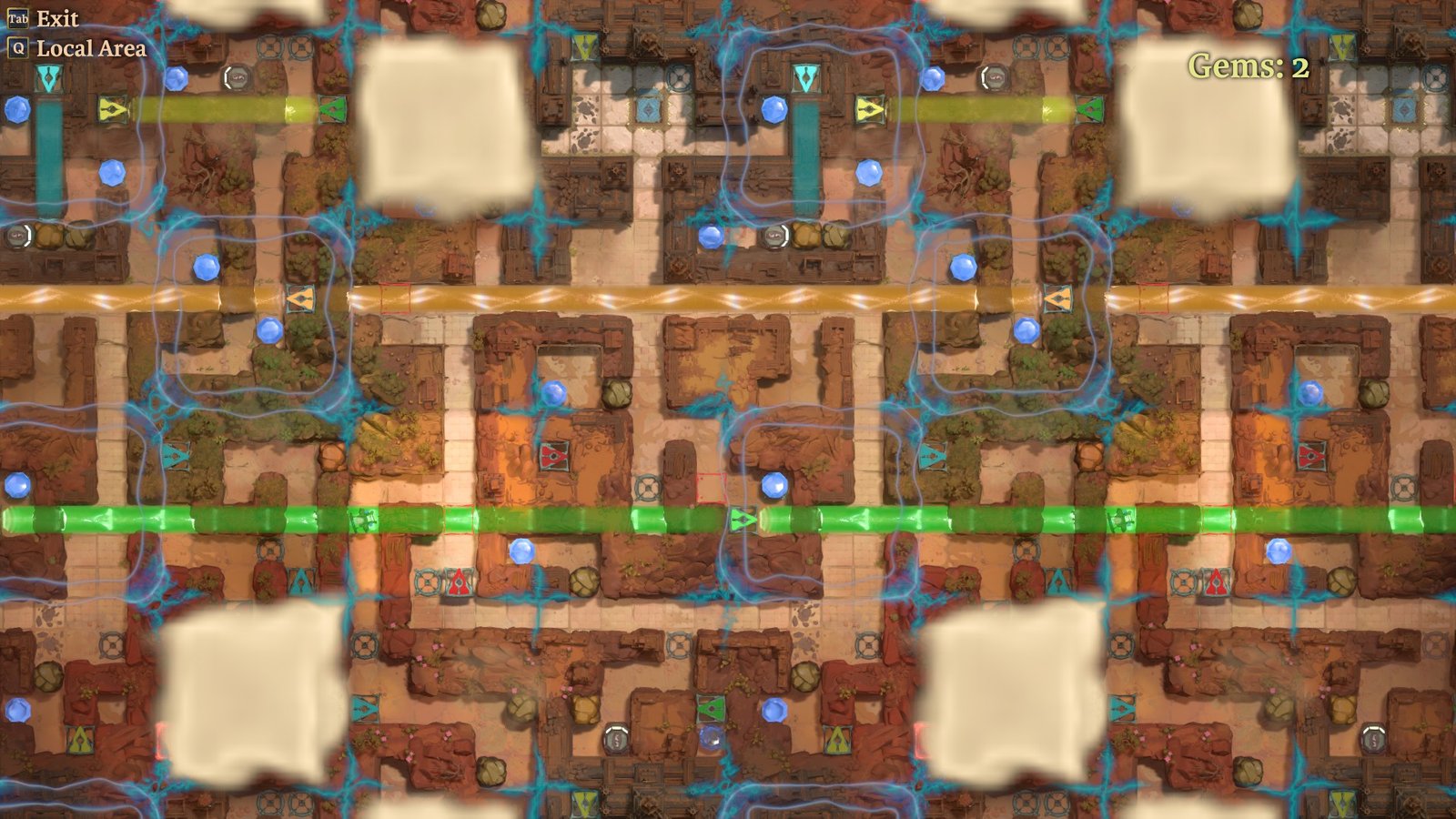
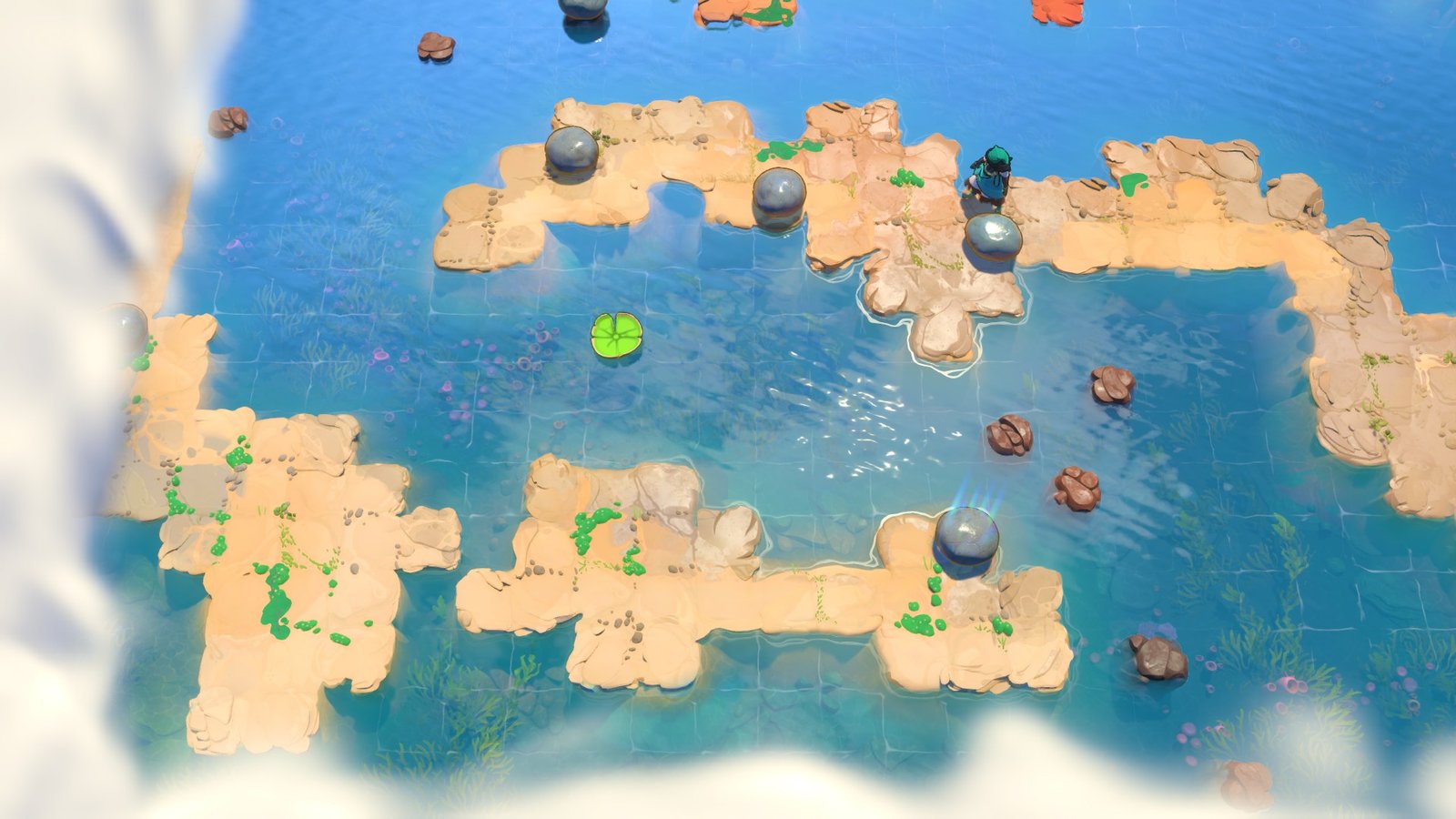
To the south is Skipping Stones to Lonely Hearts, likewise inspired by a game with the same name from Alan Hazelden. Here, you skim big stones across ponds, move lily pads and reroute currents of water to make paths (ala Frogger). The levels here are all interconnected, essentially a kind of sub-world in its own right. Finally to the west is Vault of the Beamcasters, a rocky land of caverns and temples where different coloured gems control different light beams, each of which has a different property, based on Promesst by Sean Barrett. Your hero can collect the gems and then use them to power up each of the beams as well as other, larger devices which require many gems, which can result in various special abilities such as phasing through walls or jumping over squares.
As you progress further, each land will start to overlap with each other, leading to some of the most inventive (and complicated) puzzles as two different rulesets collide. If you ever get frustrated with a puzzle (which inevitably will happen quite often), there’s no in-game hint or tutorial system; you simply have to puzzle your way through (or, for a lot of people, look up a guide, which will undoubtedly occur given this game’s myriad number of highly complex puzzles). However, you’re recommended to simply leave and try some different area if you’re hitting a wall, given the size of the world and the variety of different puzzles on offer.
There is an overarching story of Order of the Sinking Star, as well as numerous characters. For the four main overworld zones, each has a main character or group who will converse with each other or to themselves, with various bits of in-world banter or background lore which is delivered every time you start or solve a puzzle. Some of this is very enjoyable and naturalistic (the Hauling heroes have good camaraderie for example) but some of it feels a bit lacklustre. The ship companion of the adventurer in Skipping Stones to Lonely Hearts feels rather robotic and monotone in his delivery, while some of the lines the characters deliver feels strangely archaic, presumably a stylistic choice to make the world feel more fantastical, but occasionally I struggled to understand the real meaning.
Order of the Sinking Star professes to have hundreds of hours of puzzles if you have the time and brainpower, and that’s a claim I believe is warranted. Again, the reward for completing puzzles is fundamentally getting to complete more of them, but this time with greater variety and more complexity. It’s nice that there is an overarching narrative with characters which was absent from The Witness, but unfortunately this is easily the weakest part of the game, with the story delivered in such a slow fashion I found it difficult to keep track of what was happening.
Order of the Sinking Star is, in a way, one of the purest puzzle experiences ever created, squarely focused on its brilliantly envisaged and evolving puzzle designs. The gradual ramp up in complexity is satisfying, and solving the first few hundred puzzles feels enjoyable and rewarding. At the same time, it’s also an unwieldy behemoth which is arguably too large for its own good, where the grind of puzzles can eventually get tedious. How many players are willing to invest the hundreds of hours to solve and see all of it is another question entirely.