Demonschool is set just before the turn of the century. A prophecy foretells of the apocalypse happening when the new year arrives, where demons will take over the earth. Faye’s spent her life preparing for this day, raised to be a demon hunter by her grandfather who was the last in her family’s line to hold the mantle. Only problem is convincing anyone that demons are real, let alone that the actual apocalypse is rapidly approaching.
Right off the bat things are amiss. A group of gangsters runs the island, dictating who can come and go, or even attend the school. People are disappearing left and right and almost everyone’s memory is hazy. Demonschool doesn’t go all the way into actual Horror, but it still creates enough unease that sells the core mysteries and makes them effective at being unnerving. Since the game takes place over the course of a few months, you can see things slowly unravel as the end approaches and how some recurring background characters react to the ongoing situation. While most of the townsfolk you can talk to are mostly just for one-off jokes, there’s enough regulars around that add some insight to how everyone else outside the main ensemble are handling everything. Watching the number of people on the island dwindle over time when checking in with the census taker, or people only vaguely remembering friends or loved ones who’ve vanished is eerie and unsettling.
Most of Demonschool is largely lighthearted, though. It’s more horror-comedy than straight horror, the writing leaning hard on the irreverent and comedic side of things very clearly. It took time for it to grow on me. My initial impression was one that the game was trying too hard to be irreverent and silly. Characters leaned on their seemingly singular traits — Faye is obsessed with demons, Namako just wants to focus on school, Knute loves movies and lost media — to a degree I feared was going to get old fast and couldn’t sustain an entire game. (See any of the Persona spin-off games for an example of how catastrophic this can be.) As time went on, those fears, somewhat, subsided. Most of the cast became more rounded and had more going on than their introductions suggested. Others never really progressed. Disappointing, but given the sheer number of characters in the party (well over a dozen), it’s expected that some would get more love than others. I will say: despite all this, they all grew on me regardless. They’re a fun crew! There’s a lot of good moments and following them around on their misadventures is enjoyable.
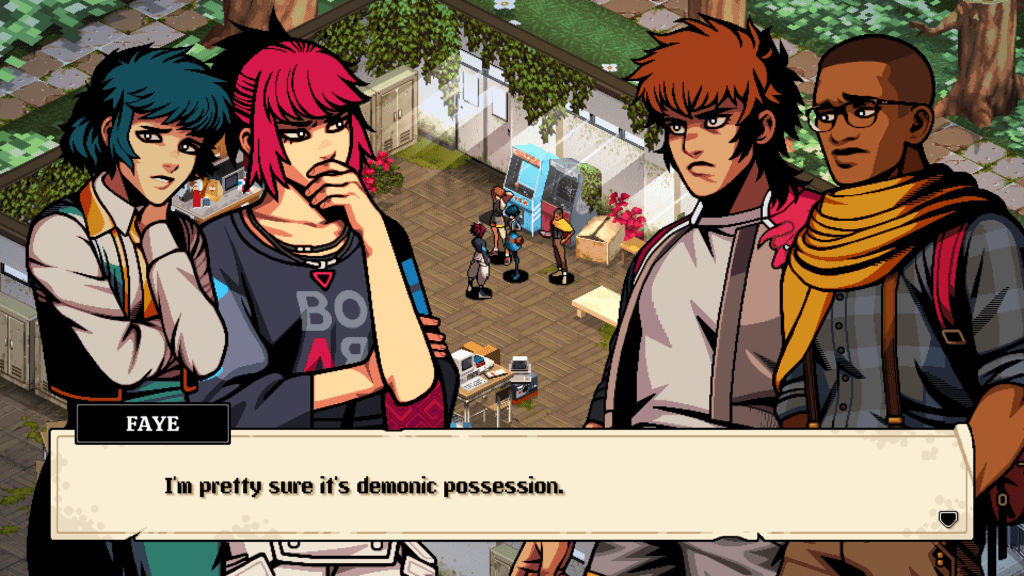
Demonschool has heart. It is earnest and unafraid of being “cringe,” letting its characters be a bunch of lovable goofs. For as much as it leans on the silly side, Demonschool crucially never goes so far that it becomes self-deprecating or refusing to give any major scenes the gravity they deserve, something that could easily happen in lesser hands. It’s ultimately a story about the strength of community in the face of disaster, the entire island’s populace eventually stepping up to help fight back against the growing demon presence wherever and however they can in a heartening display.
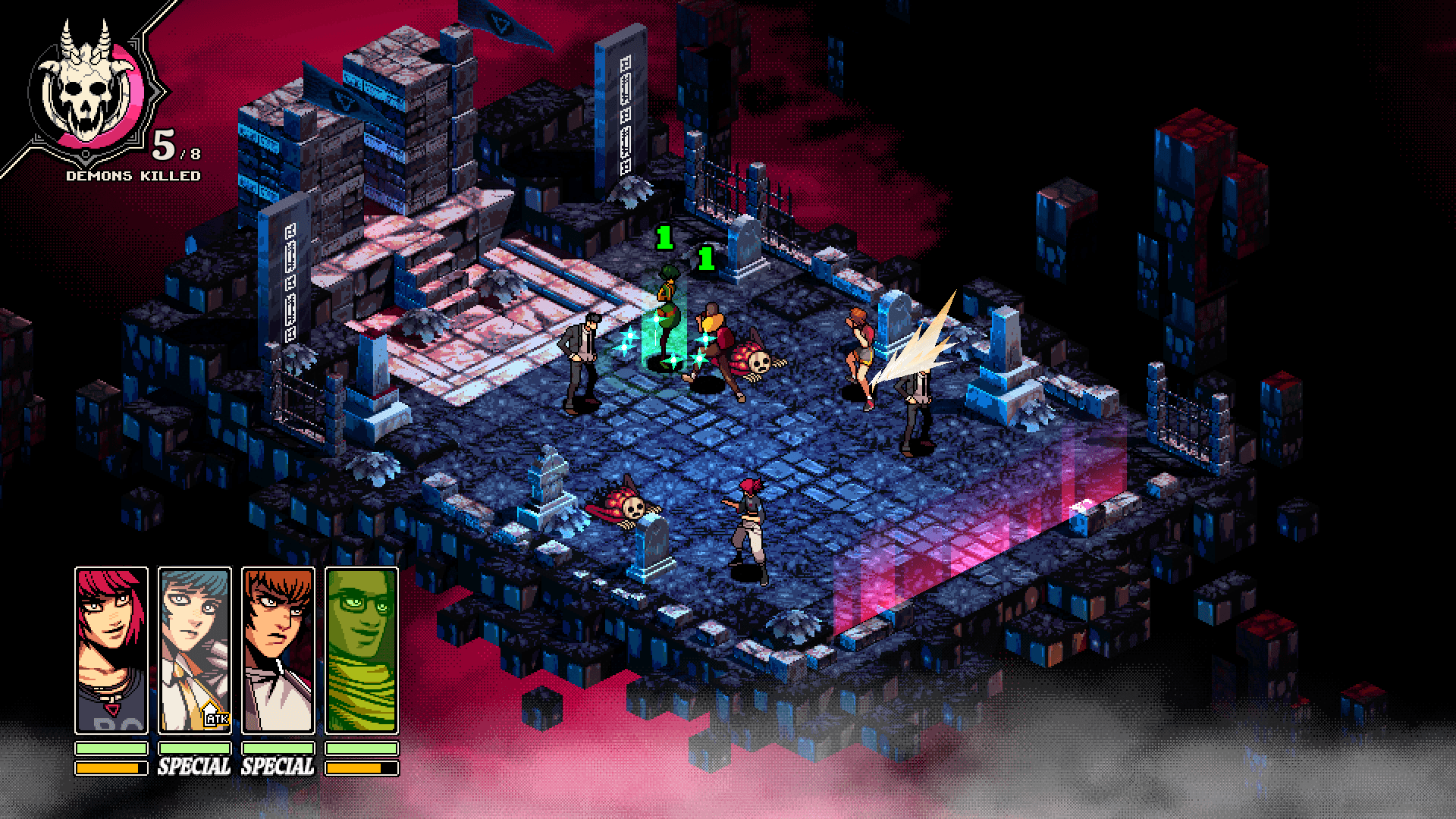
This makes Demonschool’s choice to be a tactics game fitting as teamwork is key to success here. Every battle is set on a grid where your party of four clears waves of demons until you’ve reached the requisite number to approach the opposite side of the field and close the gate. The goal is to kill the required number of foes within a certain number of turns, the fewer the better. Enemies and their positions are unchanging, allowing you to retry as many times as you like. They’re more of a puzzle in that regard, as there is always a way to clear a fight under par. The strategy comes in figuring out the exact steps to meet that goal, what skills to equip your team with and how best to use them, and who among your ensemble to bring into battle.
You can only have a party of four in combat. Everyone has a shared pool of action points to use. There’s no limit to how much you can have any one person move or attack, but the AP cost increases with each successive action. Relying on one or two characters too much means you’ll have less actions overall than if you made equal use of the entire team. But also you sometimes really need to only use a certain pair or trio after the first turn, so it’s a constant struggle to find the most efficient path to victory.
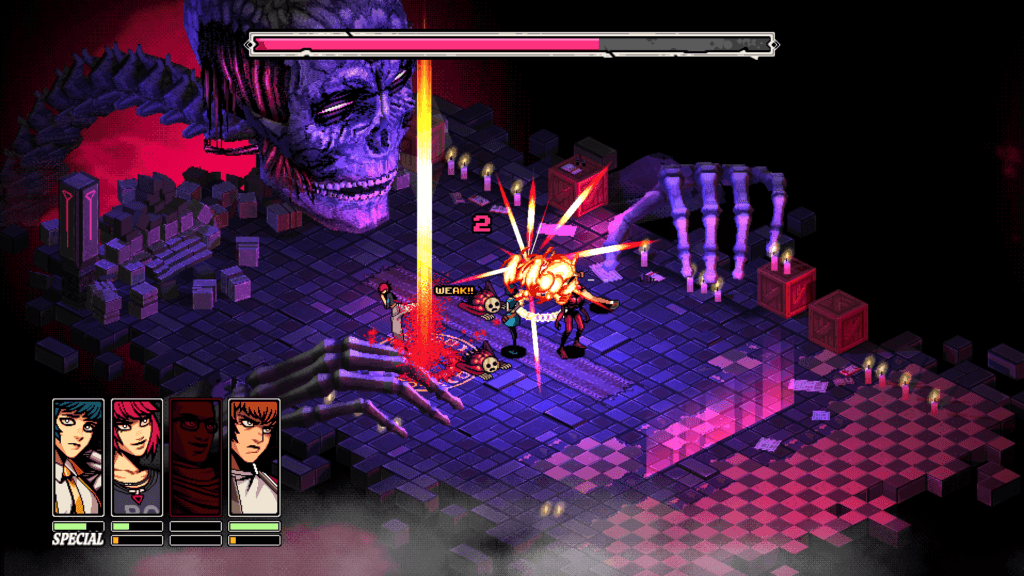
There’s a lot of ways to do that. Pushing enemies around so that you can hit several in one shot with a powerful punch, using their own attacks and statuses against them, using team attacks to deal higher damage to stronger targets: some options take more work and setup to accomplish, but the results make the effort worthwhile. Stumbling into them by chance makes it all the more satisfying when they occur at a critical moment.
For most of my playthrough, I spent the time trying to figure out how to clear every single battle under par because I enjoyed the process. Because so much of the variables of each battle are consistent, the puzzle each encounter presents can be solved with enough time and attention. It’s not a matter of restarting fights until you get a lucky seed to work with that lets you attain victory, it’s merely one of understanding where you might have gone wrong and what you can adjust to make bring about the desired outcome.
However, due to the game’s length (my playthrough took around 40 hours), even though I enjoyed the core foundation of combat, it does drag a bit on occasion due to the sheer number of fights you encounter. While Demonschool does give you plenty of characters and abilities to play with, as any RPG, once you settle on a team and kit them out properly, you’re gonna just use them whenever possible. The game does smartly force you to use certain characters in enough fights to force you to change your approach occasionally, which does prove to be a fun challenge especially when your party is split in certain stretches or the rare case where you’re controlling two teams in a fight, but it only does so much to keep battle fresh across 40 hours of play. It’s not a problem unique to Demonschool by any means — it’s a difficult challenge for any game that long — but it also cannot avoid it either.
Callum Rakestraw (he/him) is the Reviews Editor at Entertainium. You can find him on Bluesky, Mastodon, and his blog.