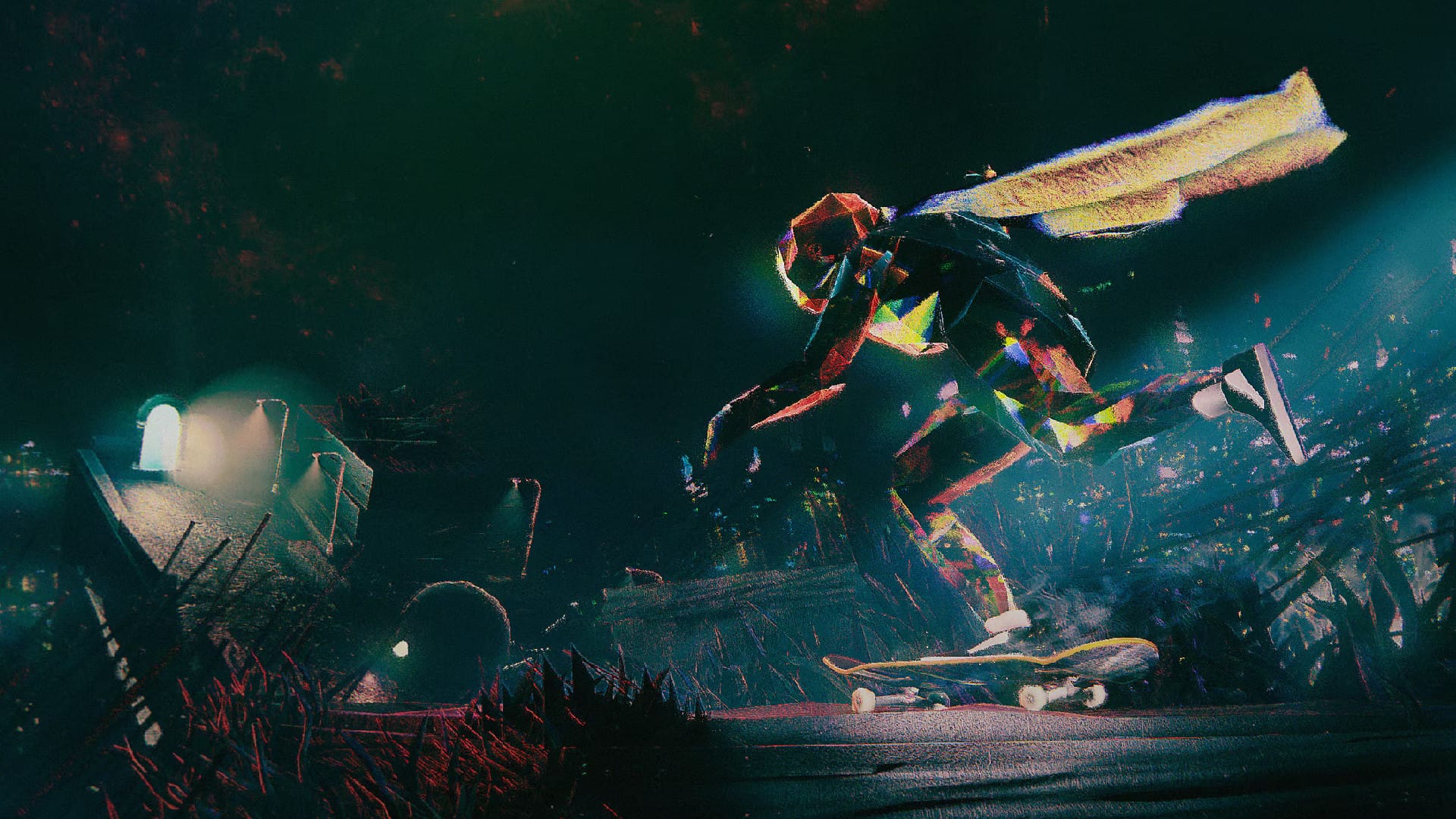
They say the devil has got all the tunes, but it turns out that he possesses a pretty rad skate park, also. Developed in New York by Sam Eng, Skate Story is an unusual take on the skateboarding game, set in a strange underworld and starring a moon-consuming demon made of glass. While its affected oddness becomes a bit wearying, and it could do with being more challenging, this is a worthwhile hadean answer to Tony Hawk enlivened by a strong soundtrack.
Skate Story wastes no time getting started. At the outset, the player character – a demon known only as the Skater – is turned to glass by the devil and given a skateboard. A deal is struck: if the skater can acquire and consume a series of colourful variants of the moon, he will be released from the underworld. The game consists of a series of small, linear environments each of which is a segment of hell in which a moon can be accessed. Along the way, the Skater learns the various tricks of his trade, needed to rack up points, complete challenges, and defeat enemies and bosses.
Quite early on, a familiar pattern to gameplay emerges. Eng has implemented a small number of scenarios which repeat regularly. One of these is the portal chase, a breakneck rush down a linear corridor-like area, often involving the Skater chasing after someone or something. Next there may be a wider urban area, superficially open and with many trick opportunities – perhaps a shop to purchase cosmetic board parts and stickers. When a key MacGuffin item or a moon draws near, a boss arena is inevitable.
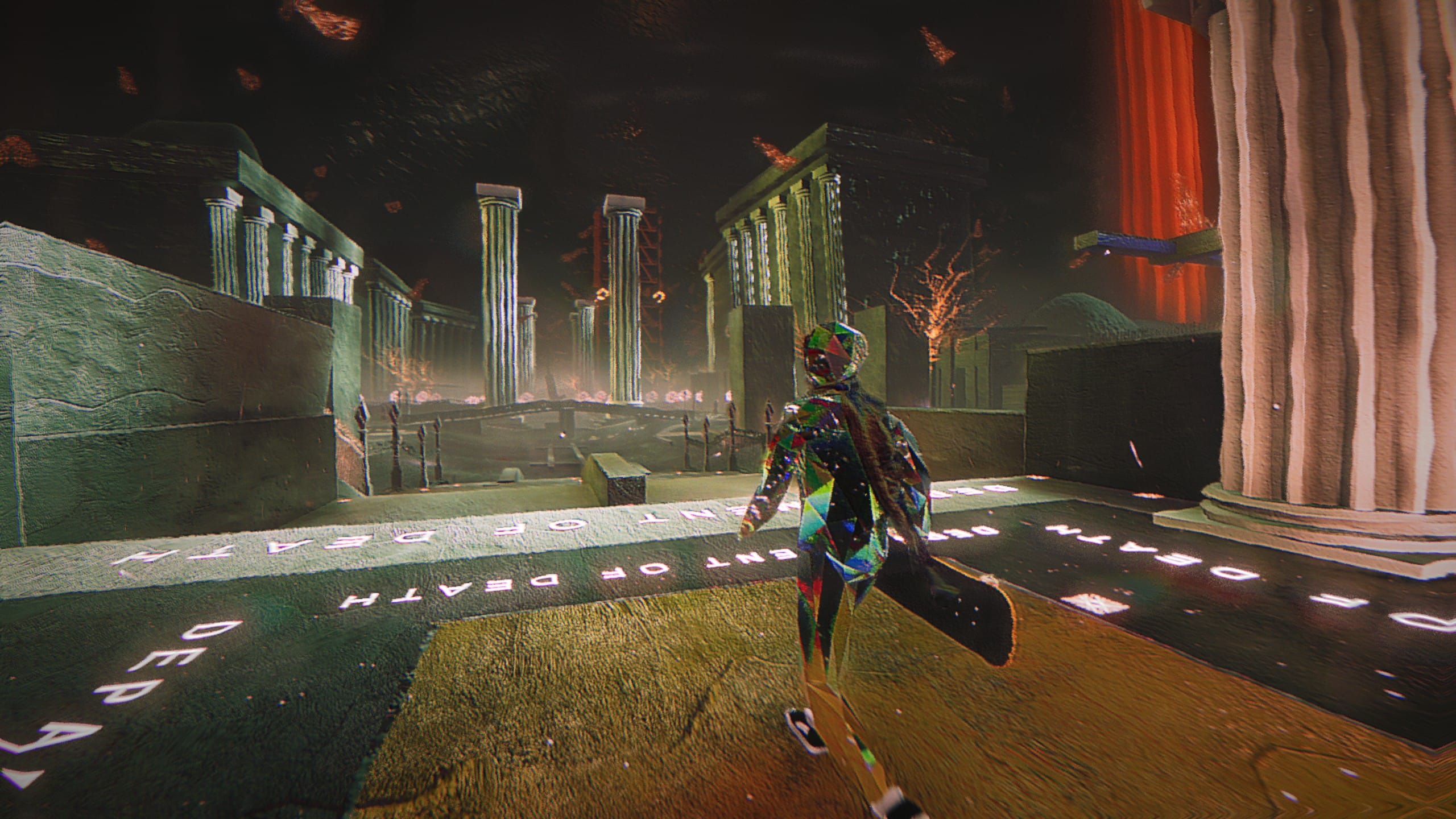
Eng’s game is genuinely strange in a way which is engaging, at least at first. The warped, glitchy aesthetic of the underworld, refracted through the Skater’s crystalline body, is unique. Spectral fish swim through the sky, a many-legged subway car scuttles between stations, and a vast barbed eye glowers down. Many areas resemble stages or dioramas, a thin skein of order over a formless nothingness which gives Skate Story a dreamlike feel. Certain fragments of a “real” urban landscape, like streetlamps and gift shops, are fuzzy intrusions into these odd scenes.
The writing only occasionally matches up to the visuals, however. Skate Story is surprisingly talky, with various tortured denizens of the underworld having much to say to the mute Skater. There are some funny jokes, but the script – which unfortunately is unvoiced – quickly becomes repetitive and feels largely empty of point or purpose. The Skater encounters a glassy rabbit, philosophers made of stone, a host of guilt-ridden skeletons, and the devil’s sentient laundry – but they seldom seem to add up to anything.
Underneath the distinctive look and off-the-wall writing is a relatively conventional skateboarding game – at least in some ways. All the familiar moves are available, and executed using an eminently logical control scheme. But where Skate Story differs is in its perhaps counter-intuitively grounded attitude to skateboarding. Points are acquired and challenges completed, yes, but the Skater rarely gets big air or executes much in the way of gravity-defying feats.
Instead, Skate Story emphasises precision and grace over excess. Grinds are generally short, and tricks lift the Skater just a little way off the ground. Small mistakes will throw the Skater to the floor, smashing his glass body. Eng’s admirable intention was to reflect the feeling of fragility brought by skateboarding, which pits the frail human body against concrete, steel, and tarmac. This is undermined to a degree by the instantaneous respawns, which generally trivialise failure.
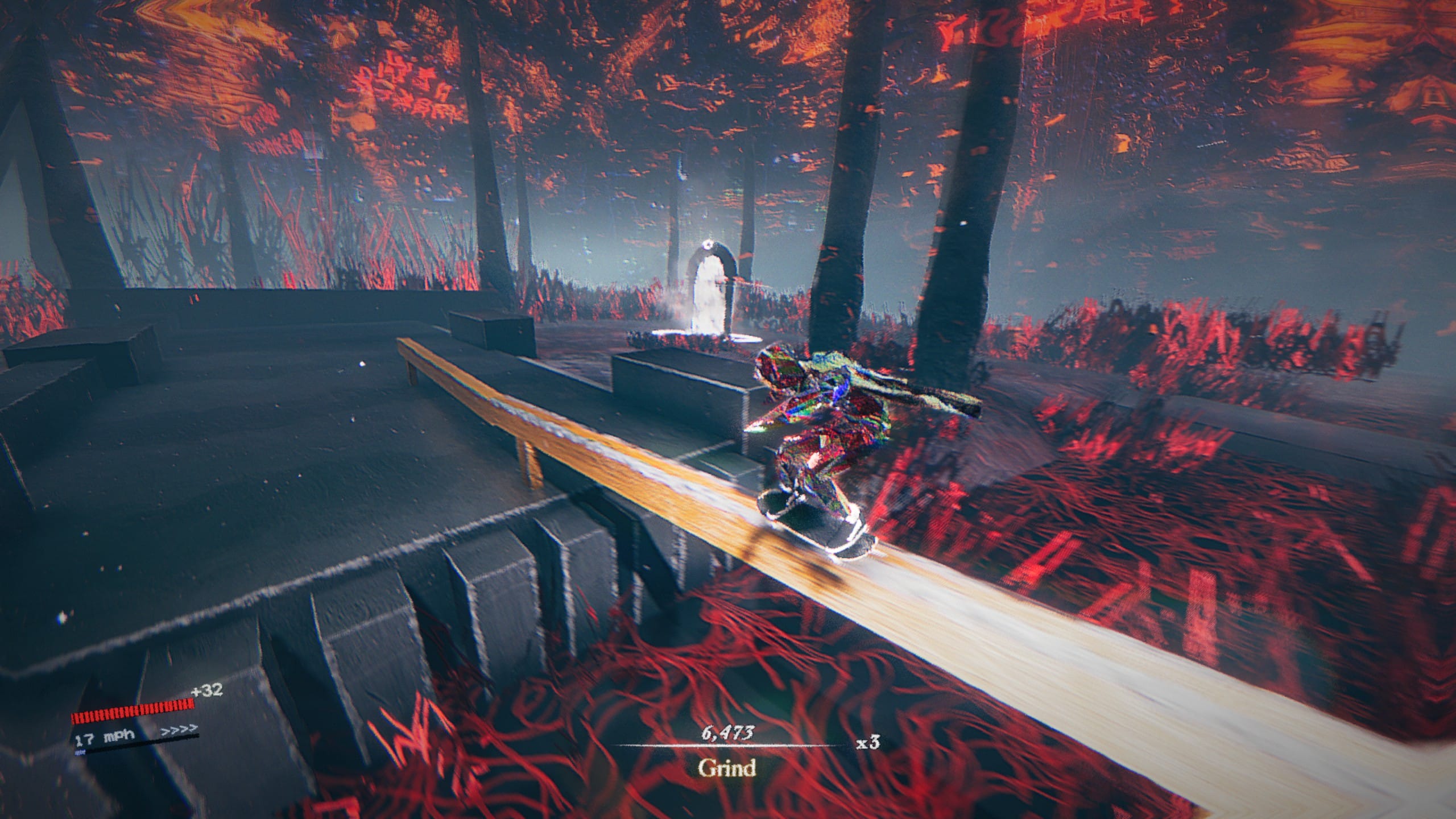
More generally, Skate Story is not particularly challenging. There are frequent boss battles – of a kind – in which the Skater must land tricks in particular areas to chip away at the health of some kind of underworld entity, be it an all-seeing eye or a blood moon. These bosses generally can’t fight back, so the player’s only real opponent is the clock. Gangly, long-legged foes represent the underworld’s sleep police, but are barely a threat to the Skater. They too are vanquished by executing tricks, and even rudimentary ones will do the job. Often the only real challenge is grappling with Eng’s choice of a close, erratic camera, which looks great but too often obscures the action.
There is a paradox at the heart of Skate Story which is that this is in some senses a quite realistic depiction of skateboarding, wrapped up in a thoroughly surreal and otherworldly aesthetic. The skating is engaging and dynamic, but the narrative – such as it is – feels ad hoc and half-baked, a loose assemblage of odd events and images that don’t amount to much. The visuals and soundtrack are strong draws, but it is the gameplay through which Eng best communicates what he has to say about the unique experience of skateboarding.