Thanks to films like The Imitation Game, the story of the cryptographic work undertaken at Bletchley Park during the Second World War is relatively well understood, even if the finer details often get lost. Breaking the German cryptographic codes, particularly the Enigma machine, was a combination of effective espionage, daring raids of U-boats and other locations, including by Polish armed forces, and cold hard maths. It very likely helped to significantly shorten and win the war, especially due to the counter-espionage efforts of planting false information.
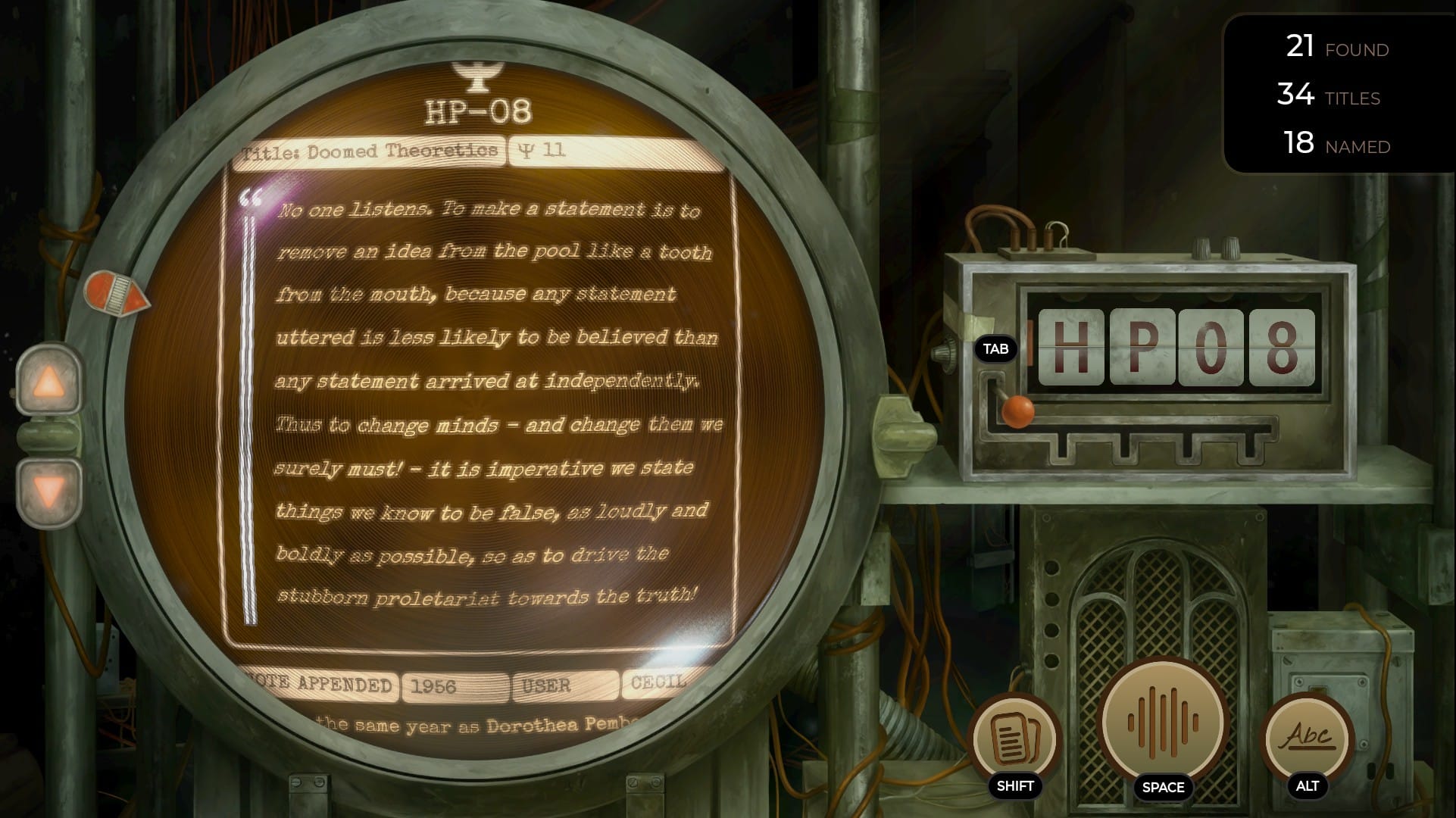
TR-49 is a science fiction puzzle game set in an alternative universe where one such codebreaking machine becomes vastly more powerful than originally predicted. You play as Abbi, locked in a crypt beneath Manchester Cathedral, confronted by the TR-49 device, which you must search through to uncover its secrets. The TR-49 machine resembles part Enigma machine, part cathode ray tube device, part oscilloscope. The screen looks like the computers from Terry Gilliam’s 1985 film Brazil, with the circular monitor only able to display limited information at one time. Your sole companion over the radio is Liam, who is asking you to search through the computer for records of a novel, “Endpiece”, and to delete it.
This novel, and the TR-49 machine itself, have been central to altering the fabric of reality, creating what are known as “revisions”; points in time where history changes. The “Endpiece” novel has somehow allowed the rich and powerful to live forever, turning the world into a totalitarian nightmare (even more than the real world of today is!). Liam hopes that deleting the novel from the machine will erase it from history, and therefore undo the revision. The story does go to a number of different places regarding Abbi’s own involvement, the history of the machine and the life stories of all those associated with it, resulting in a number of different endings (you can easily see all of them if desired).
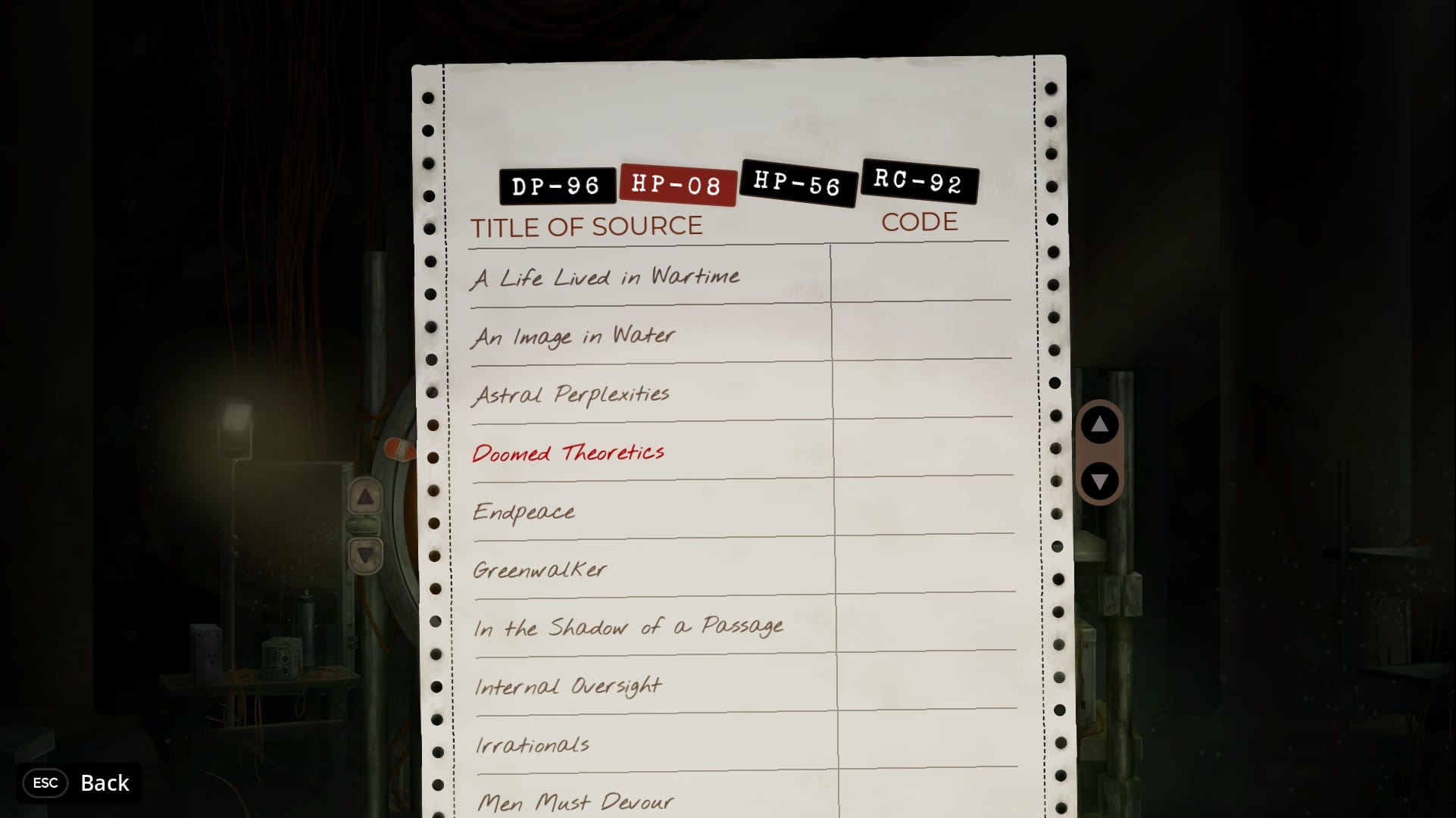
TR-49 is a game which feels like a merger of Her Story, Return of the Obra Dinn and The Roottrees Are Dead, combining the deductive aspects of the former with the clunky, old-fashioned computer interface of the latter. Each record in the machine has a catalogue reference made up of two letters and two numbers. You can input any record number you want, but you have no idea which ones will return results. The machine is also very glitchy and will often display garbled text and gibberish, but the text will become more legible when you correctly assign the catalogue number to the correct title. A record may say a novel was published the year an author died, or may say they’re associated with another writer. You can use this information to gradually piece together a broader picture.
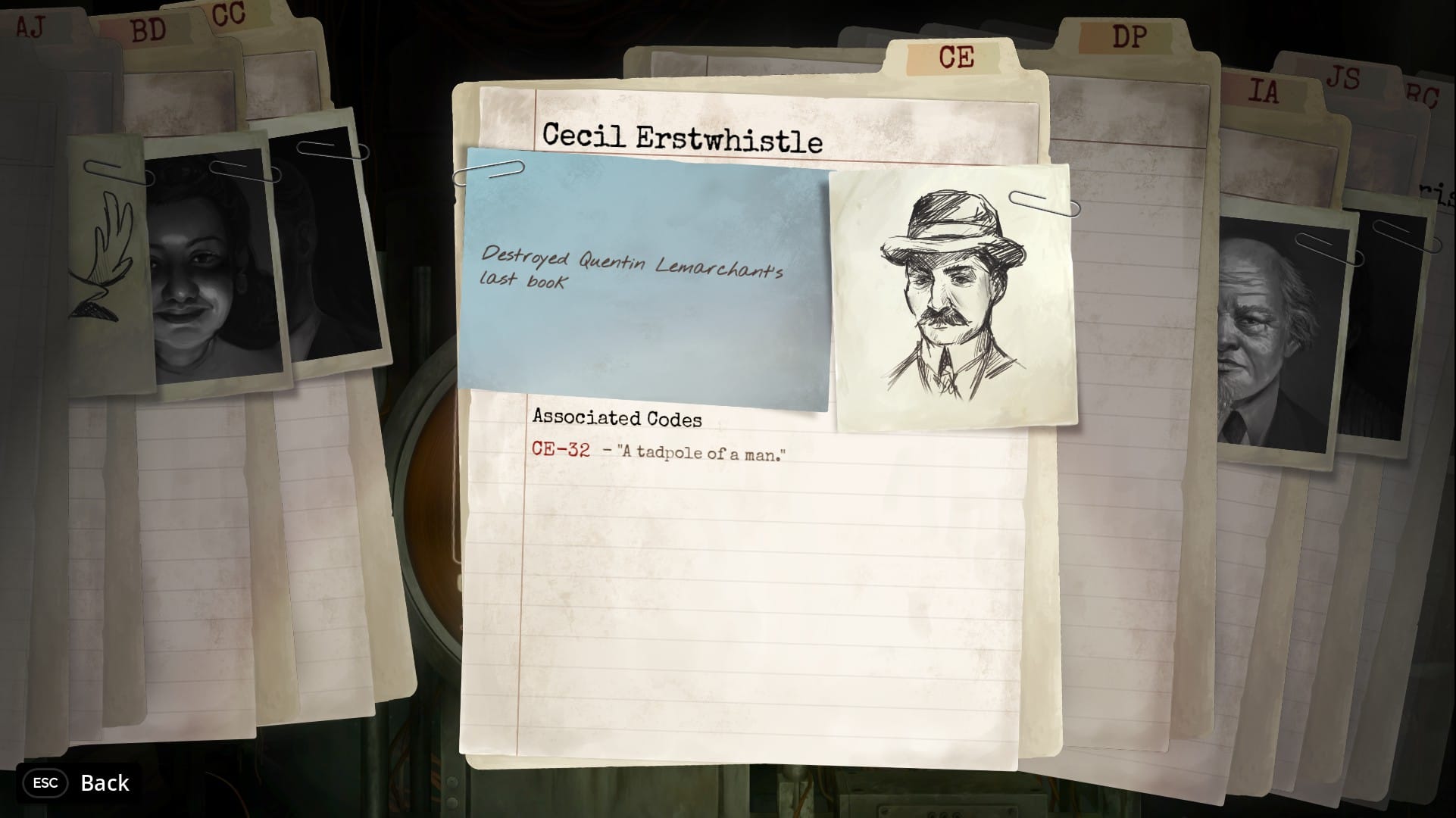
There are fifty records in total to discover (with some more extraneous ones as well which aren’t necessary to advance the story) and fifty literature titles to match up to their catalogue reference. For example there are numerous issues of “Academicalist’s Journal” within the database, but you might not know which issues, or which year they were published. You do have a handy set of notes which auto-populate as you learn information, showing you all the different authors and their associated catalogue records. Some authors might only have a single record while others might have half a dozen, but their picture icon will fully be painted once you’ve found all of their records.
TR-49 lives and dies on its narrative hooks and I was continually intrigued to dive deeper, especially as the banter between Abbi and Liam feels naturalistic, although Abbi is perhaps a little too accepting of her situation, thrust into performing this task without much preamble. Nonetheless the interwoven narrative exploring the development of the TR-49 machine, and the various pieces of literature that were fed into it is fascinating, with little voiced snippets of each book being readable once you’ve correctly identified the title. I would have appreciated a bit more backstory into how the alternate universe came about in the first place, but the variety of endings gives a good sense of closure.
Unlike Inkle’s 80 Days there’s not much replayability here but uncovering the mystery is consistently enjoyable, although I could have done with a bit more variety in the visuals, as the entire game is played simply looking at the TR-49 device or your notebook. But the story has a great deal of resonance to our current era, where falsehoods are brazenly peddled by fascist governments, and where speaking the truth is sometimes an act of rebellion. TR-49 is another fine addition to Inkle’s growing roster of narrative adventures.