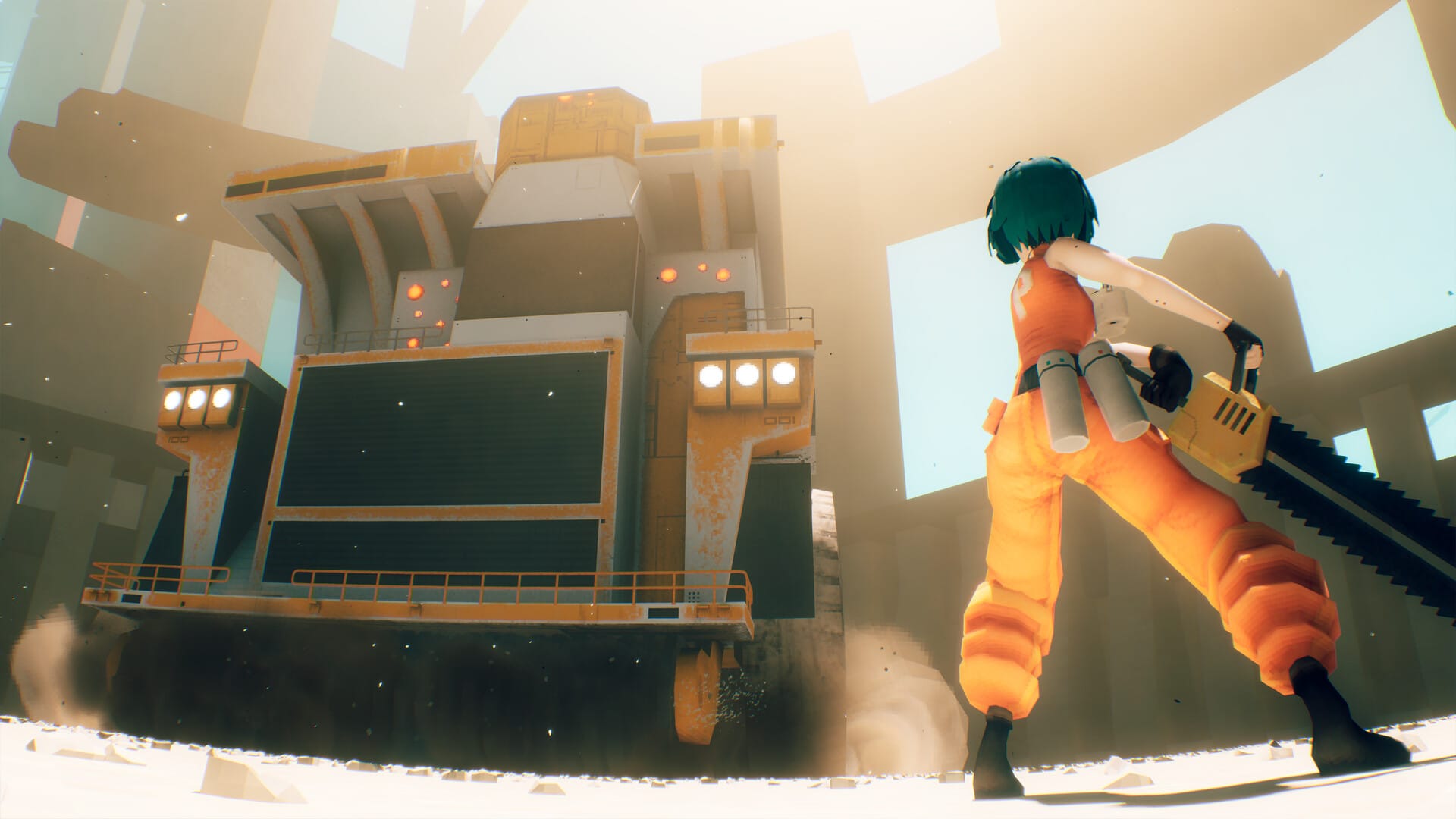
Motorslice is a platformer where you navigate a sprawling megastructure fighting autonomous and hostile machines along the way. You play as P, a slicer who’s been assigned to investigate this structure and destroy all the machines roaming within. These machines, often construction oriented vehicles, are considered “corrupted” – identifiable by the orange glow they exhibit when viewed via a visor – and therefore dangerous. They attack on sight, whether in self-defense or through some directive to attack any flesh and blood being, who can say. But destroying the machines is only half the job. The other half is getting to the top of the structure to find out what’s there.
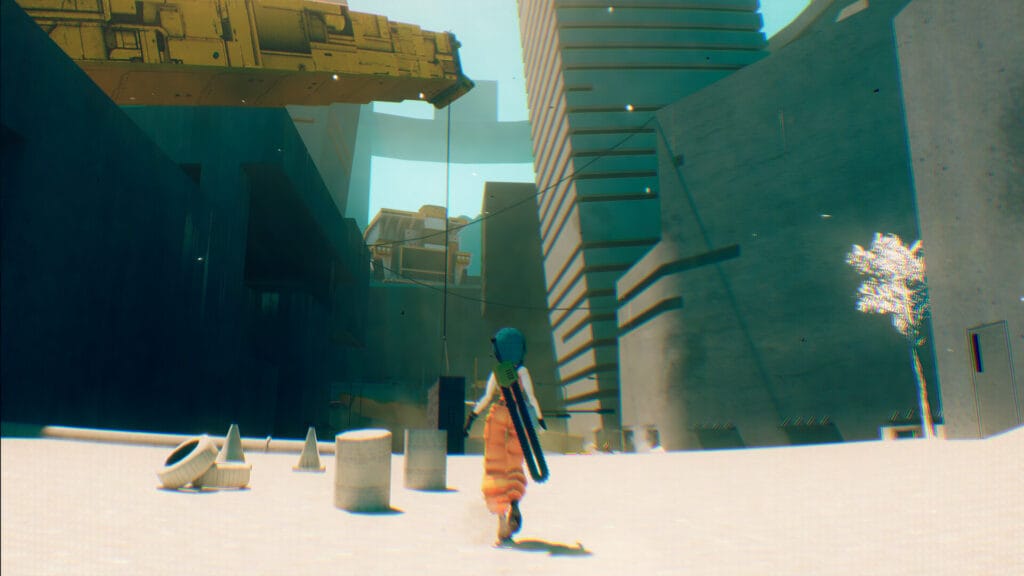
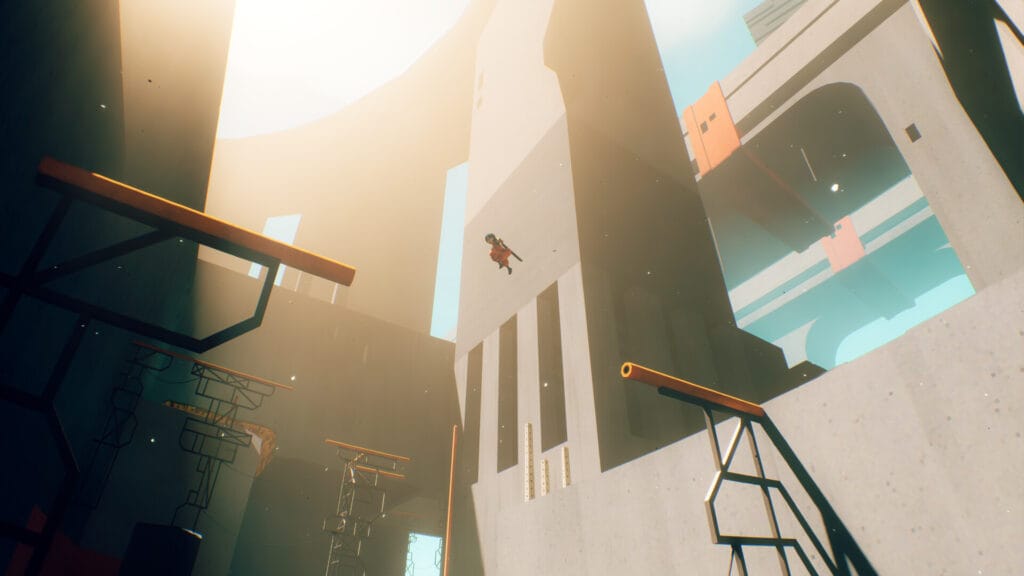
Motorslice’s space is huge. Not just in the obvious scale of the place, every building and pillar towering over you, but also the amount of ground you cover. Many examples of megastructures in games communicate the scope of the space by obscuring the limits of its reach. The structure keeps stretching off into the distance, seemingly endless in its coverage of the landscape. Motorslice is no different, its own boundaries extending far and wide, its confines so dense that your glimpses beyond are narrow and fleeting. But it’s through play that it best communicates the sheer scale. You can see and feel how vast this place is as you move through it because you experience so much of it directly.
Every chapter leads you through its own winding section of the structure. It’s never a straight path upward, twisting all around, regularly making you question whether your immediate surroundings are just set dressing or space you’ll run through later. As you ascend the central spire that connects each leg of the climb, you can look down and see where you’ve been. The corpses of mammoth machines, reduced to rubble, marking your progress as the scale of the space stretches out around you.
The boss fights that occur at the end of each chapter similarly thrive for the sheer size and spectacle of your opponents. Combat is very simple in Motorslice – most machines you fight go down with a single slice of your chainsaw – but boss enemies stand out because of how they leverage one of the more stylish means of climbing. Certain surfaces allow you to stick your chainsaw into them use it to propel yourself forward. In many of the game’s best moments, these sequences integrated into proper platforming sequences where P seamlessly moves between cutting along walls and running and jumping along them. Against bosses, these walls serve as the sole means of inflicting damage. Battles are more of an extended platforming challenge than a straightforward clash. Getting onto the vehicle you’re pitted against is as much the challenge as navigating its body and cutting each of its vulnerable points.
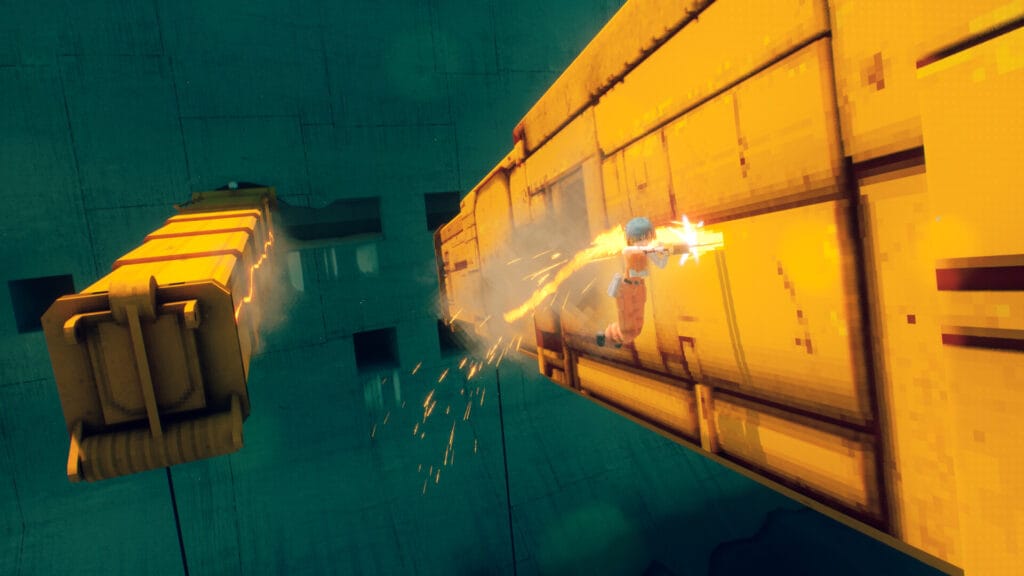
While a good number of them can be easily boarded, plenty require a bit of inventive thinking. One mid-game example sees you having to topple the boss using the high-power fans resting below the platform so you can slice the underside of the vehicle. In one late-game example, I parried an oncoming train and rendered it inoperable instead of merely hopping aboard as it passed me by. Motorslice leans on spectacle above all else in these scenes, less concerned with trying to be an interesting challenge and more with what looks and feels cool.
It’s Motorslice‘s guiding principle. Moving through the megastructure is exciting for the myriad ways you get to play with its excellent movement and how it revels in the satisfaction of besting its obstacles. Almost every inch of the megastructure is a challenge to navigate, in large part due to ways Motorslice pushes you to be particular about when to make your move. Straightforward challenges like leaping back and forth wall running through a corridor to avoid the pitfall below can be complicated by whether you got what extra distance you could from your initial jump before latching onto the wall or vice versa. Positioning and timing is everything. Learning and understanding when to make these tiny adjustments makes running at the same obstacle over and over worth it, even when you’re constantly failing. Puzzling out what you’re doing wrong and dialing in the correct motions is an enjoyable process because there’s just enough of a margin for error to work around. It makes the eventual success feel like an accomplishment, especially as the sequences grow in complexity and danger.
There are points where it falters due to how difficult P can be pilot in specific circumstances. Most of P’s abilities are context sensitive. P will run up or along walls simply by jumping toward them, requiring no extra input on your part. Just hold the analog stick forward and she’ll handle the rest. For the grand majority of Motorslice, this works well. It allows you to string together actions seamlessly and focus on positioning and timing than juggling inputs on top of that. It creates the slick action parkour aims for: that feeling of moving through rooms and over obstacles like water, every step executed in one flawless motion.
But it does lead to some occasional frustration when the game doesn’t quite read your directional inputs the way you wanted, such as when you wanted to run up a wall but were at a slight angle when you made contact and instead ran left or right along the wall. Or how she’ll keep climbing a ledge you’re trying to very carefully hop off so you can cut into and ride it with your chainsaw. It’s a trade-off. Motorslice captures the thrills of parkour splendidly in part because of the ease it offers in making these movements flow together. That the game misinterprets your intent occasionally is unfortunately par for the course with handing over direct control over some actions. Motorslice never gets in the way such that makes any task impossible, but it never becomes any less annoying when it leads to you falling to your death on occasion.
Callum Rakestraw (he/him) is the Reviews Editor at Entertainium. You can find him on Bluesky, Mastodon, and his blog.